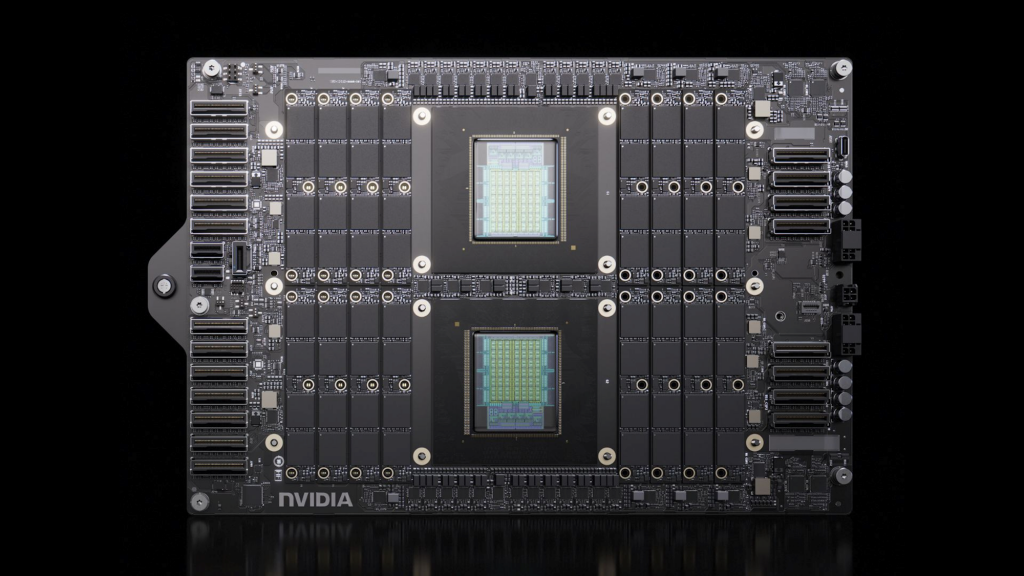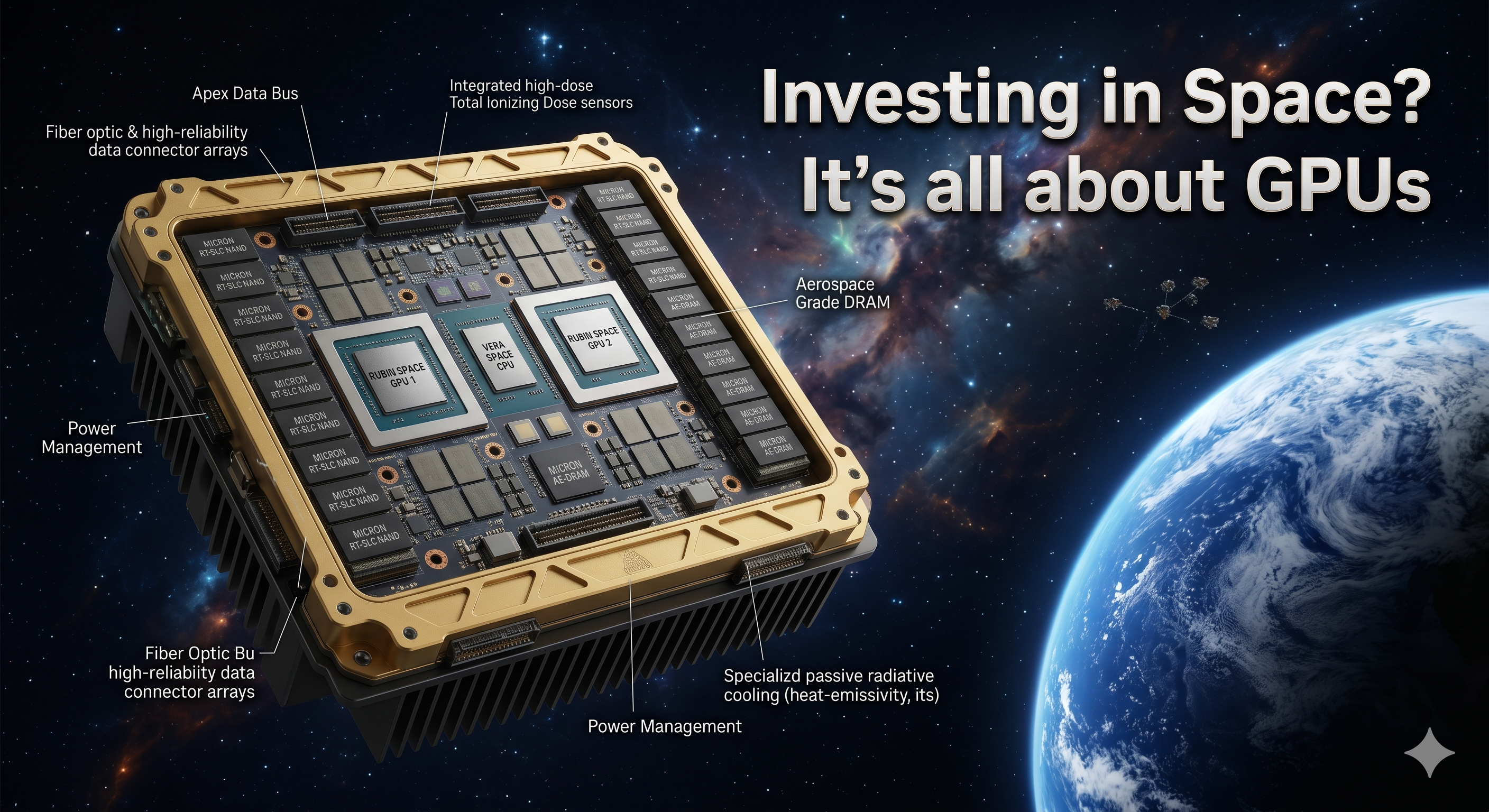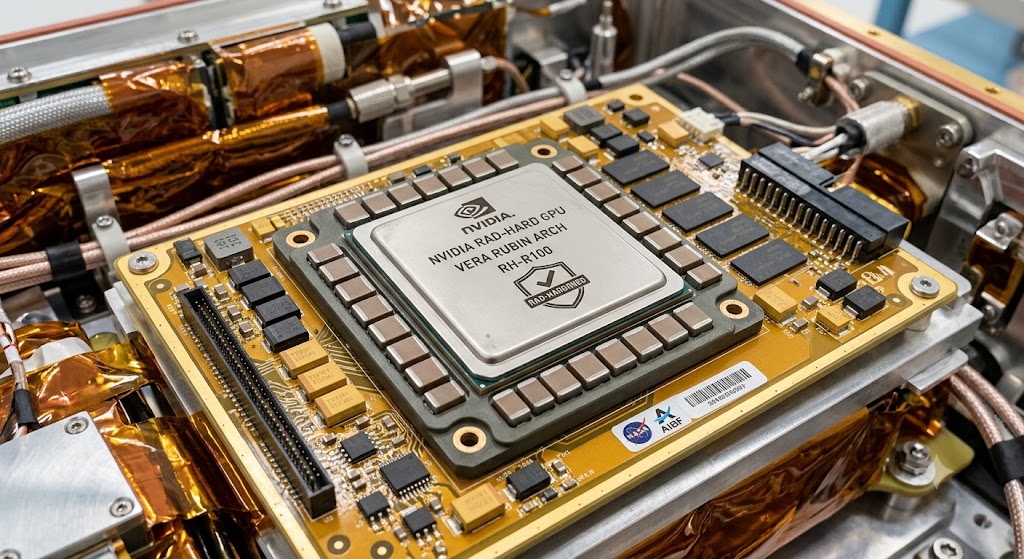
The NVIDIA Rubin architecture (officially named the Vera Rubin platform after astrophysicist Vera Rubin) represents NVIDIA’s next-generation leap beyond the Blackwell line. Moving from a single hardware refresh to an “extreme co-design” strategy, NVIDIA is building entire rack-scale supercomputers designed explicitly for the inference and agentic AI era rather than just brute-force training.
Production shipments are scheduled to begin in Q3 2026, with a massive volume ramp following in Q4 2026 and into 2027.
1. The Core Chips: Rubin GPU & Vera CPU
Instead of relying on third-party host processors, the flagship data center configuration pairs NVIDIA’s own custom ARM-based processor with their high-end graphics compute core:
- NVIDIA Rubin GPU (R100): Built on TSMC’s advanced 3nm-class process, a single Rubin GPU houses 336 billion transistors (a massive 61% density leap over Blackwell’s 208 billion). It delivers up to 50 PFLOPS of dense NVFP4 (4-bit floating point) inference compute.
- NVIDIA Vera CPU: A purpose-built, high-bandwidth ARM-compatible host processor designed specifically to handle ultra-fast data movement and deterministic performance for multi-agent reasoning loops.
- HBM4 Memory Integration: Rubin is the first architecture to fully transition to HBM4 memory. A single GPU features 288 GB of HBM4 delivering up to 22 TB/s of memory bandwidth—nearly triple the speed of Blackwell Ultra. This allows a massive 400-billion-parameter AI model to execute inference entirely on a single GPU, eliminating the typical latency bottlenecks caused by spreading models across multiple cards.
2. Platform Architecture: The Vera Rubin NVL72 Rack
NVIDIA’s primary enterprise deployment vehicle is the Vera Rubin NVL72, a unified, liquid-cooled, liquid-coupled rack system that functions logically as one single giant processor.
Core Rack Specifications
| Component / Metric | NVL72 Rack Capacity | Per Single Superchip (2x GPU, 1x CPU) |
| Total Processors | 72 Rubin GPUs / 36 Vera CPUs | 2 Rubin GPUs / 1 Vera CPU |
| CPU Core Compute | 3,168 custom “Olympus” ARM cores | 88 custom “Olympus” ARM cores |
| NVFP4 Inference | 3,600 PFLOPS (3.6 ExaFLOPS) | 100 PFLOPS |
| NVFP4 Training | 2,520 PFLOPS (2.5 ExaFLOPS) | 70 PFLOPS |
| GPU Memory & Bandwidth | 20.7 TB HBM4 @ 1,580 TB/s | 576 GB HBM4 @ 44 TB/s |
| CPU System Memory | 54 TB LPDDR5X | 1.5 TB LPDDR5X |
| Interconnect Speed | Sixth-Gen NVLink Switch (260 TB/s) | NVLink-C2C (65 TB/s) |
3. Co-Processing & Networking Upgrades
To prevent the immense compute power of the Rubin chips from starving for data, the NVL72 architecture incorporates updated networking and specialized logic:
- NVIDIA Groq 3 LPU Integration: In a significant hardware collaboration, the NVL72 architecture natively integrates Groq 3 LPX accelerator logic directly into the fabric. Armed with 128 GB of ultra-fast on-chip SRAM per rack, this co-processor handles ultra-low latency requirements and massive million-token contexts.
- ConnectX-9 SuperNIC: Upgrades per-GPU networking throughput to 1.6 Terabits per second (Tb/s) with hardware-enforced, remote direct-memory access (RDMA) for smooth scaling across massive multi-rack clusters.
- BlueField-4 DPU: Manages background storage, infrastructure security, and network virtualization directly within the data stream, keeping the core CPU and GPU cycles entirely unburdened.
4. The Client Space: RTX Spark (PC/Laptop)
Beyond the massive data center racks, the Rubin architecture is trickling down to high-end endpoint hardware via the RTX Spark platform for laptops and desktop workstations. Targeting Windows on Arm systems, these client-side implementations pair the Rubin consumer architecture with ultra-fast LPDDR6 memory to run heavy, agentic local AI models without pinging cloud infrastructure.
Following the initial 2026 rollout, NVIDIA plans to launch a dual-core Rubin Ultra architecture in 2027, followed by the next-generation Feynman architecture in 2028.
The Nvidia Vera Rubin Changes Everything video breaks down the massive leap in raw engineering specifications, system architecture, and architectural scale found in Nvidia’s newest enterprise platform.