Investing? Rad-Hard GPU Development & Space Computing News
The commercial space paradigm is undergoing a massive architectural shift. Spacecraft are transitioning from simple “data-collect and downlink” platforms to autonomous orbital data centers. Historically, space-bound processors were limited to slow, heavily hardened FPGAs or standard CPUs.
The device manufacturers’ point of view indicates that high-performance, parallel GPU architectures are now mandatory for real-time image analysis, hazard avoidance, and orbital AI inference.
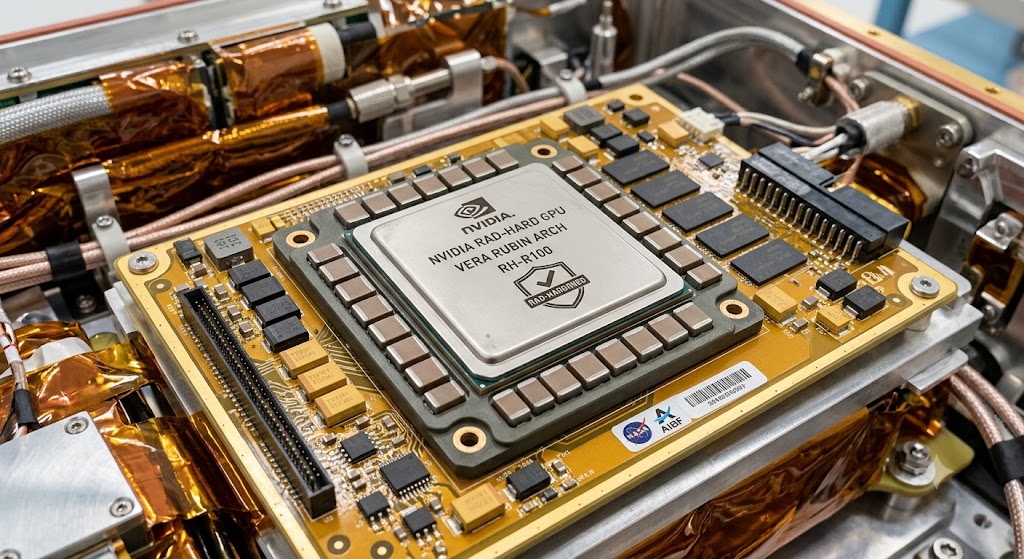
NVIDIA Enters the Cosmos: The Vera Rubin Space-1 Module
At the GTC conference, NVIDIA officially claimed its stake in the space sector by unveiling the Vera Rubin Space-1 Module.
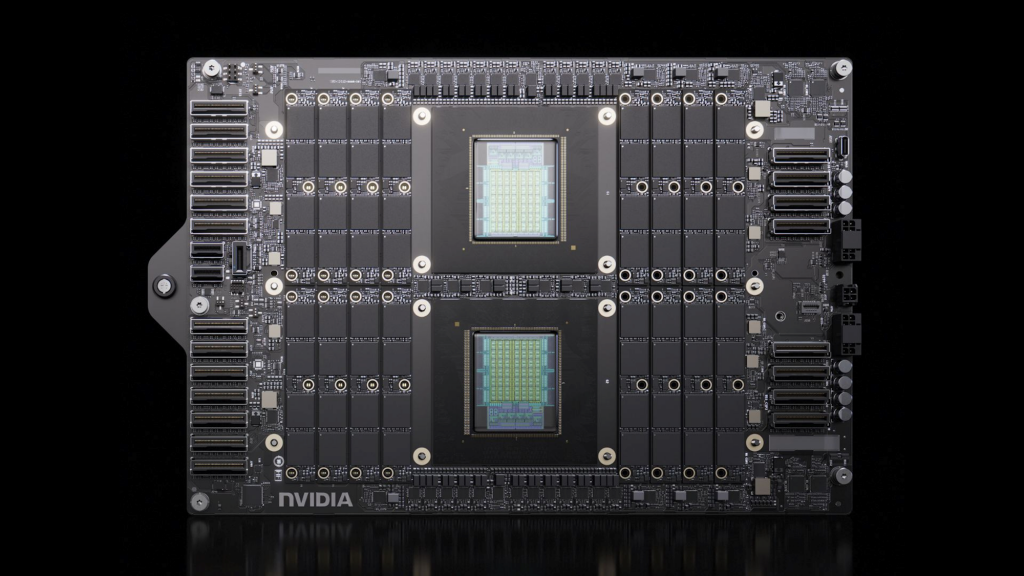
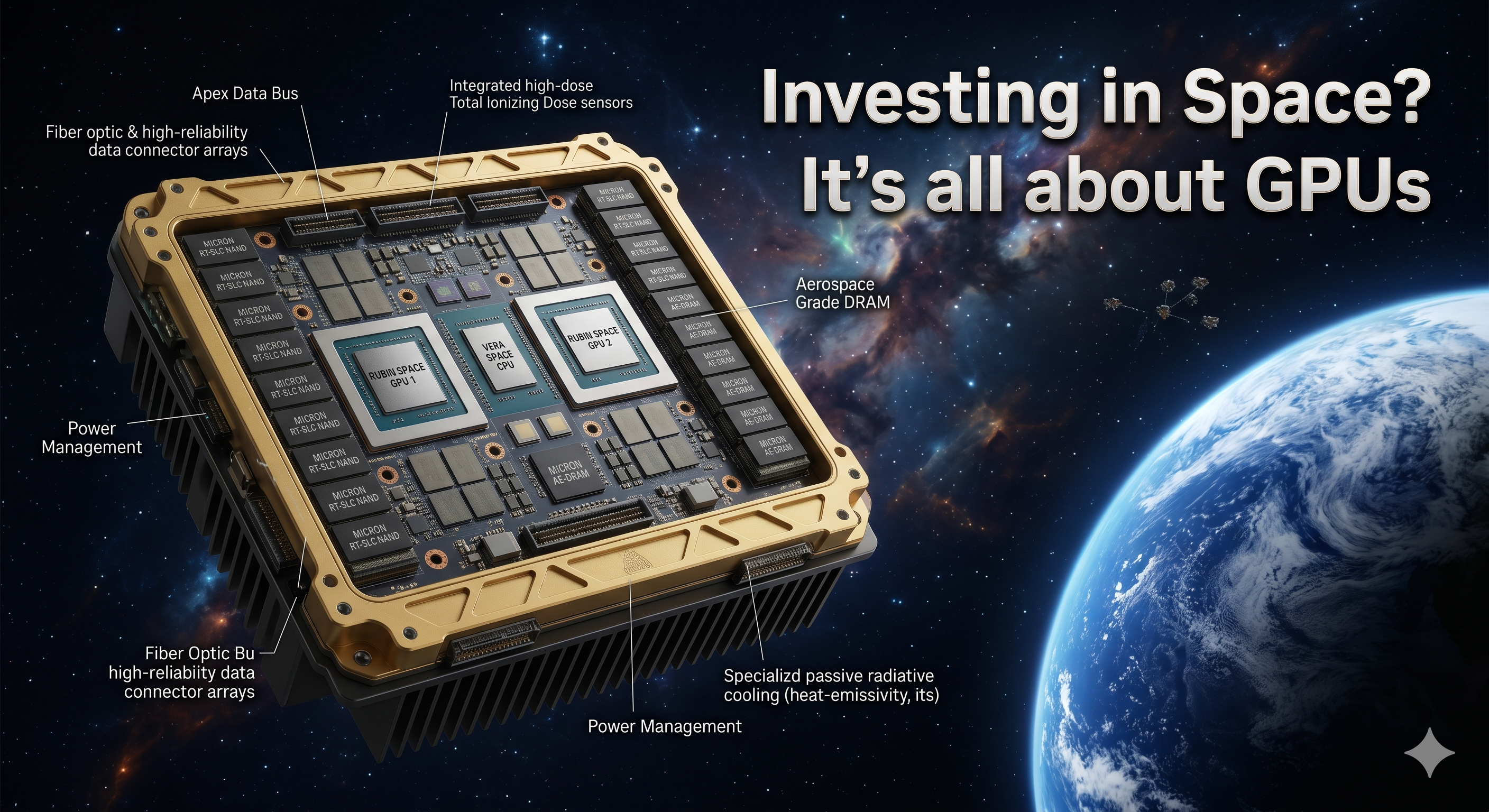
- The Hardware: The system pairs two Rubin architecture GPUs with one Vera CPU, utilizing high-efficiency LPDDR5X memory.
- The Paradigm Shift: NVIDIA claims a 25× leap in AI compute performance for orbital inference compared to trying to adapt legacy architectures. This allows Earth-observation satellites to process hyperspectral data and run AI models (like Google’s Gemma or NanoGPT) entirely in Low Earth Orbit (LEO).
- The Engineering Hurdle: Device manufacturers explicitly note that thermal management remains a critical constraint. In a vacuum, there is no convective or conductive cooling; heat dissipation relies entirely on radiative structures, capping the thermal design power (TDP) constraints of these orbital modules.
Commercial Off-The-Shelf (COTS) Mitigation vs. Traditional Hardening
Recent technical validations (including Starcloud’s successful deployment of an NVIDIA H100 GPU to orbit on a 60 kg satellite) reveal that the industry is leaning heavily on a hybrid mitigation approach rather than pure process-level physical radiation hardening.
- Manufacturing a proprietary, fully radiation-hardened GPU from the silicon substrate up takes years and trails consumer performance by decades.
- Instead, manufacturers are using advanced software-level error correction, redundant voting architectures, and specialized silicon-on-insulator (SOI) protective shielding to let high-performance commercial silicon survive the Single-Event Effects (SEEs) and Total Ionizing Dose (TID) threats of LEO.
NASA’s Autonomous Space Processor Mandate
NASA recently formalized its push for specialized AI space processors. The agency’s focus is on hardware that can withstand deep-space radiation while running real-time target selection and autonomous navigation algorithms for lunar and Martian deployments—reducing dependency on the restrictive latency of Earth-bound Deep Space Network communications.
Is Micron Capturing the Space Fabrication Market?
There is a common misconception in market rumors regarding Micron’s exact role. Micron is not a foundry (like TSMC or Intel Foundry Services) capturing the fabrication market for third-party space logic chips like GPUs. Instead, Micron is dominating a highly specialized, high-margin niche: Space-Qualified, Radiation-Tolerant Memory Infrastructure.
Without reliable, ultra-dense memory, a high-performance space GPU is useless. Micron has successfully positioned itself as the definitive backbone supplier for the orbital data boom through several key initiatives:
- The 256 Gb Space-Grade SLC NAND Flash: Micron shocked the aerospace market by launching the highest-density radiation-tolerant single-layer cell (SLC) NAND flash memory on Earth. This 256 Gb chip is specifically designed to withstand the extreme vibration, thermal cycling, and cosmic radiation of space.
- Rigorous Space Qualification: Micron’s space portfolio is not just “ruggedized” COTS. Their testing pipeline aligns tightly with NASA’s PEM-INST-001 Level 2 flow, featuring 590 hours of dynamic burn-in, total ionizing dose (TID) testing under military standards (MIL-STD-883), and extensive Single-Event Effect (SEE) heavy-ion trials.
- The Sovereign Supply Chain Factor: As a premier U.S.-based memory manufacturer ramping up domestic production at its Manassas, Virginia facility, Micron offers a completely secure, ITAR-compliant supply chain. Defense agencies and aerospace primes (such as Mercury Systems, whose data recorders use Micron memory on the International Space Station) are heavily favoring Micron because it mitigates geopolitical and supply chain risks.
- Roadmap: Micron is aggressively expanding this footprint, with space-qualified NOR flash, high-density DRAM, and advanced aerospace-grade DDR variants scheduled to roll out over the next 12 months.
Reality in Fab and Dev for Apex
To evaluate the engineering and manufacturing timeline for deploying the specialized NVIDIA Vera Rubin Space-1 Modules within the initial orbital footprint of the Project Apex AI Data Centers, there must be an establishment of a baseline deployment variable.
Project Apex bridges ultra-dense parallel computing with the radical operational throughput of Starship V3 logistics. While traditional terrestrial data centers scale across hundreds of thousands of standard GPUs, initial orbital data center constellations face unique thermal, mass, and volumetric bounds.
Baseline Architecture & Scaling Assumptions
- Initial Operational Footprint: 48 dedicated orbital data center nodes (deployed across low Earth orbit planes for global coverage and localized edge caching).
- Density per Orbital Node: 1,280 Vera Rubin Space-1 Modules per satellite chassis, structurally governed by radiative cooling surface area and power constraints.
- Total Initial Component Target: 61,440 Space-1 Modules (requiring 122,880 Rubin-architecture space-shielded GPUs and 61,440 Vera space-grade CPUs).
- Fabrication Bottleneck: Silicon fabrication uses TSMC’s advanced nodes, but the real timeline strain stems from aerospace qualification workflows, packaging, and integration with Micron’s radiation-tolerant SLC NAND flash and specialized packaging.
Technical Project Timeline: Production to Orbit
The following matrix assumes a unified fast-track manufacturing directive, balancing advanced consumer silicon scaling with stringent aerospace hardware assurance protocols.
| Phase | Milestone / Activity | Estimated Duration | Cumulative Timeline | Critical Dependencies & Risk Factors |
| Phase 1 | Silicon Tape-Out & Substrate Procurement | 2 Months | Months 1–2 | Securing advanced wafer allocation via TSMC; bulk allocation of specialized silicon-on-insulator (SOI) layers for high-altitude single-event effect (SEE) mitigation. |
| Phase 2 | Wafer Fabrication & Foundry Operations | 3 Months | Months 3–5 | Lithography processing of Rubin space architectures. Includes embedded sensor arrays for real-time radiation-induced latch-up protection. |
| Phase 3 | Aerospace Packaging & Micron Memory Integration | 2 Months | Months 6–7 | Multi-chip-module (MCM) assembly pairing the dual GPUs, the Vera CPU, and Micron’s NASA Level 2 certified space-grade flash infrastructure. |
| Phase 4 | Environmental Stress Screening (ESS) & Rad-Testing | 3 Months | Months 8–10 | Intensive thermal-vacuum chamber (TVAC) cycles, high-dose total ionizing dose (TID) radiation bombardment, and high-frequency structural vibration staging. |
| Phase 5 | Module-to-Chassis Avionics Integration | 2 Months | Months 11–12 | Mechanical population of the 48 data center bus units. Rigorous validation of structural heat sinks and power management systems. |
| Phase 6 | Orbital Insertion Logistics & Deployment Staging | 2 Months | Months 13–14 | Launch campaign integration using Starship V3 architectures. Rapid payload deployment and on-orbit constellation initialization. |
Phase Breakdown & Engineering Constraints
1. Wafer Level Constraints (Foundry Stage)
NVIDIA’s consumer-grade silicon leverages massive economies of scale. However, the Space-1 modification requires proprietary physical changes at the mask level to introduce hardware-level spatial redundancy (such as triple-modular redundancy for critical control blocks). This limits wafer yield compared to standard commercial runs.
2. The Multi-Chip-Module (MCM) Integration Bottle-neck
The module pairs logic directly with high-performance memory. Micron’s extensive testing pipeline (requiring nearly 600 hours of continuous dynamic burn-in and deep characterization for single-event upsets) dictates that memory must be fully provisioned and validated up to two quarters before the module’s final encapsulation.
3. TVAC and Qualification Realities
Unlike terrestrial hardware deployments, where a failed node can be hot-swapped by a field technician, orbital hardware has a zero-tolerance failure threshold.
Critical Dependency: Thermal-vacuum (TVAC) chamber availability is the ultimate constraint. Simulating deep space thermal cycling while running heavy artificial intelligence workloads requires unique infrastructure, forcing batches to be qualified in strict parallel blocks.
Summary Readiness
Based on this aggressive yet achievable model, the first operational orbital cluster can achieve full constellation readiness approximately 14 months from final design lock and component procurement authorization.
While there are roadblocks calore and bottlenecks in fabrication and delivery, the fact remains, this plan, while perhaps overly ambitous in the final stage can be accomplished initially. The company is stable, and will remain so, depending on its many other areas of implenmentation.
Apex is doable, whether it can be fully realized is for another day. Right now, as a company, Apex or no Apex, the company has a steady foundation due to established staff. Leadership is a concern, but as a public entity its leadership is less locked in and can be addressed readily.