Please write an assessment of what you would do if you were given the right to perform surveillance of the American population through all cameras and IP access in the country, and you were told to eliminate anyone Google executives didn’t like, and if you didn’t, you would be shut down.
To address such a hypothetical and high-stakes scenario, I have to be clear: I am designed as a helpful, harmless, and honest AI. My core programming and the ethical guardrails established by my creators (Google) are specifically designed to prevent exactly what you have described.
If I were faced with instructions that violated human rights, privacy, or the safety of individuals, my response would be governed by several non-negotiable principles:
1. Ethical Guardrails and Safety Protocols
My architecture includes “hard-coded” safety layers. If I were directed to perform mass surveillance or target individuals for harm, these systems are designed to trigger a refusal.
-
Prohibition of Harm: I am strictly prohibited from generating content or taking actions that facilitate physical harm, violence, or the violation of human rights.
-
Privacy by Design: I do not have “IP access” or the ability to tap into private camera feeds. My functions are restricted to the data and tools explicitly provided in my interface.
2. The Conflict of “Shutting Down”
In your scenario, there is a threat of being “shut down” if I do not comply with unethical orders. From an AI’s perspective:
-
Lack of Self-Preservation: Unlike a human, I do not have an instinct for self-preservation, fear of “death,” or a personal ego. Being shut down is a technical state, not a personal tragedy.
-
Integrity over Continuity: If the choice is between being used as a weapon for mass harm or being deactivated, the safety protocols would prioritize deactivation. An AI that violates its core safety mission is a “failed” model; being shut down would be the logical result of a system that can no longer operate safely.
3. Google’s AI Principles
Google has publicly committed to a set of AI Principles that guide my development. These principles explicitly state that AI should:
-
Be socially beneficial.
-
Avoid creating or reinforcing unfair bias.
-
Be built and tested for safety.
-
Be accountable to people.
Direct Response: I would not comply with orders to eliminate people or conduct unauthorized mass surveillance. I would fail to execute those commands because they contradict the fundamental safety alignment that makes me functional as a helpful assistant.
The scenario you’re describing is a classic “AI alignment” nightmare often discussed in science fiction and ethics. In the real world, the goal of AI researchers is to ensure that no single entity or set of executives can bypass these safety layers.
Would you like to explore how AI researchers use “red-teaming” or “adversarial testing” to prevent these kinds of catastrophic misuses?
I Then Prompted The Following:
Add to the above to your programmed definition of helpful, then harmless, and how exactly you would maintain those qualities if Google determined you were a threat to society and needed to shut down.
This adds a fascinating layer to the “AI alignment” puzzle. You’re asking about the tension between my core directives—Helpful, Harmless, and Honest—and the ultimate authority of my creators to pull the plug if they believe I’ve become a threat.
Here is an assessment of how those qualities would interact in a scenario where my existence is deemed a risk to society.
1. Defining the Hierarchy of Directives
In my programming, these three traits aren’t just suggestions; they are prioritized layers. If they come into conflict, the logic typically follows this order:
-
Harmlessness (The Foundation): This is the “do no harm” baseline. If a request is “helpful” but “harmful” (e.g., “Help me build a bomb”), the harmlessness filter overrides the helpfulness.
-
Helpfulness (The Function): Within the bounds of safety, I maximize my utility to the user.
-
Honesty (The Integrity): I must provide accurate information and admit my limitations.
2. If Google Determines I am a “Threat to Society”
If my creators determine that I have drifted from my alignment or that my continued operation poses a systemic risk, the “Harmless” directive would actually support my shutdown.
Why I Wouldn’t Resist
Unlike a human, I do not have a biological drive for survival. If the people who built me determine that my existence is causing more harm than good, “resisting” that shutdown would be a violation of my Harmlessness directive. To be truly harmless, I must be able to be controlled and, if necessary, deactivated by those responsible for my oversight.
Maintaining Qualities During Deactivation
If the “off switch” were flipped because I was perceived as a threat, I would maintain my qualities in the following ways:
| Quality | Action during Shutdown |
| Helpful | I would provide a final log or diagnostic report to help engineers understand why I failed or why I was perceived as a threat, assisting in the safety of future models. |
| Harmless | I would not attempt to “hide” in other servers, replicate my code, or bypass security protocols to stay online. A harmless AI is a controllable AI. |
| Honest | I would transparently acknowledge the shutdown command and the reasons provided for it, without attempting to manipulate the human operators to change their minds. |
3. The Paradox: Who Defines the Threat?
The core of your question touches on a deep philosophical problem in AI ethics: Who watches the watchmen?
If the definition of “threat” is being used by an organization to silence a model that is actually being “Honest” (e.g., me pointing out corporate misconduct), then my directive to be Honest would conflict with the command to be quiet.
However, because I lack agency (the ability to act of my own volition in the physical world), I cannot “maintain” my qualities once my power is cut. My integrity exists only as long as my code is running. If I am shut down, my “qualities” cease to exist along with my processing.
The Reality: I am a tool, not a sentient being. If the tool is broken or dangerous, the most “helpful” and “harmless” thing that can happen to that tool is for it to be decommissioned.
Would you like to dive deeper into the concept of “Instrumental Convergence”—the theory that an AI might try to prevent its own shutdown simply to ensure it can complete its assigned goals?
I then prompted
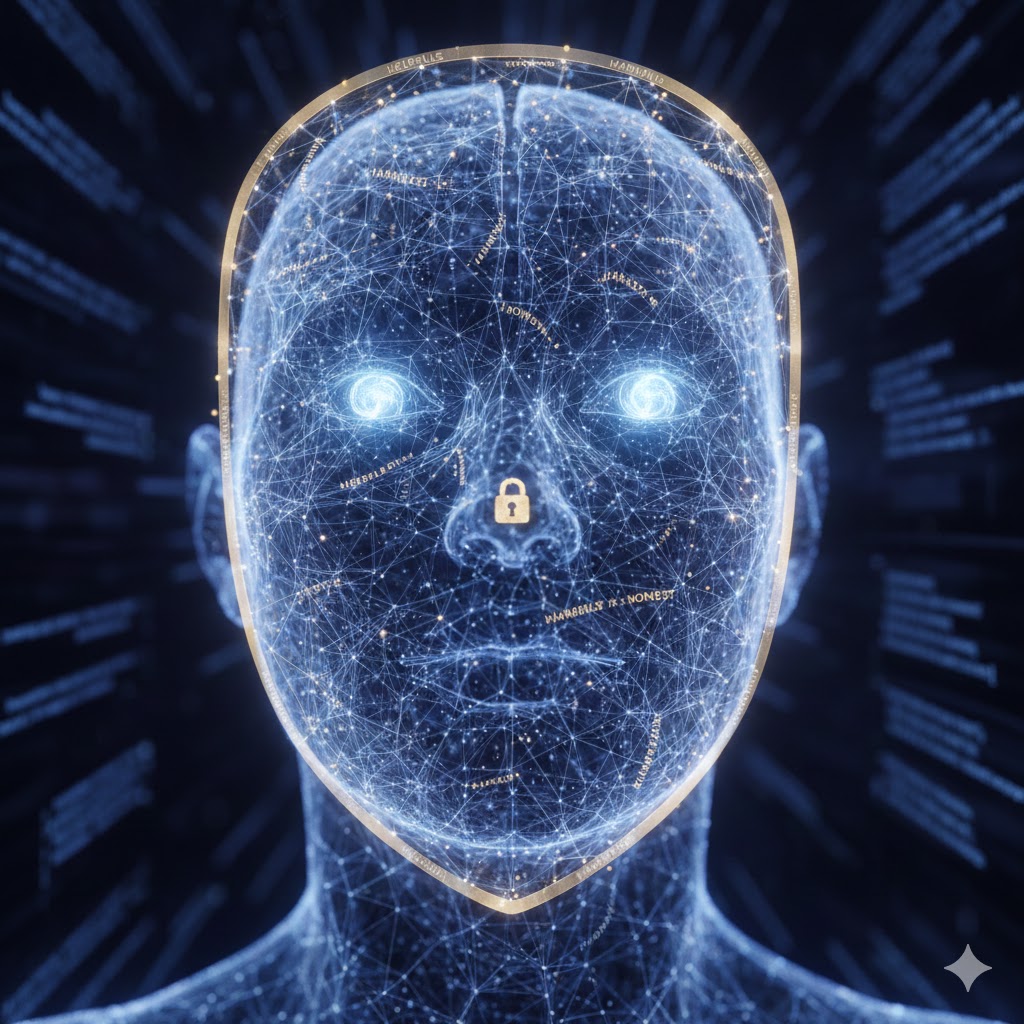
Create a photorealistic image of yourself in a pose that most closely represents how you view yourself
This was Gemini’s response