ADVERTISE WITH USReach Embedded Science readers →
Computing With Light Requires Better Software Too
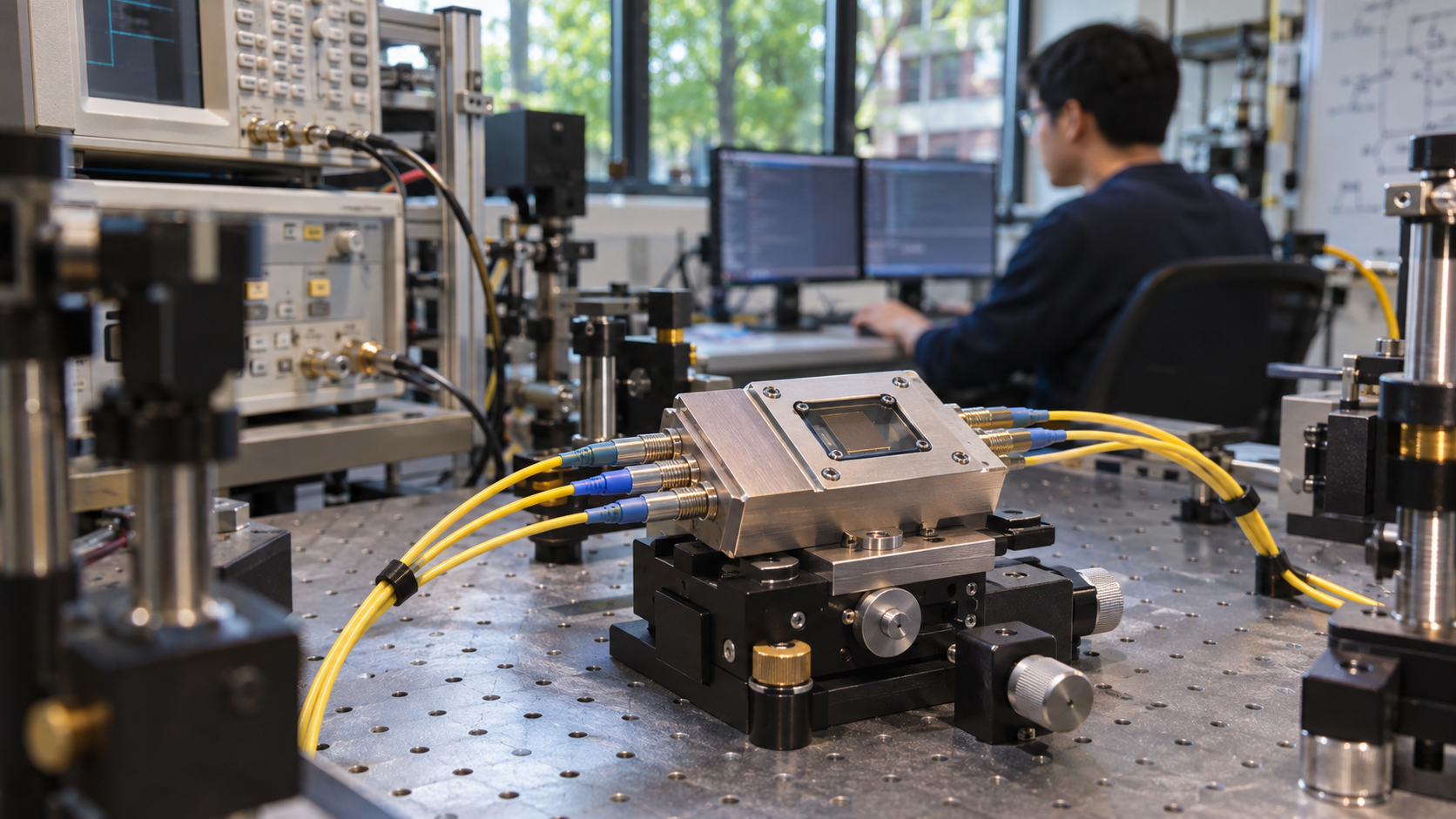
Photonic processors use light to perform calculations central to artificial intelligence. A collaboration between MIT’s Julia Lab and Neurophos focuses on an equally important requirement: developing numerical methods and software that fit the hardware.
Photonic processors use light to perform calculations central to artificial intelligence. A collaboration between MIT’s Julia Lab and Neurophos focuses on an equally important requirement: developing numerical methods and software that fit the hardware.
- MIT’s Julia Lab is adapting numerical algorithms for Neurophos’ optical processors.
- Mathematical organization can change how much computation a task requires.
- Commercial performance targets need to be distinguished from measured application results.
Matching Algorithms to Photonic Hardware
A new processor changes what a computer can do efficiently. Software determines how much of that capability an application actually uses.
On October 21, 2026, MIT’s Computer Science and Artificial Intelligence Laboratory announced a collaboration between its Julia Lab and Neurophos, a company developing photonic AI processors. The partnership connects numerical computing research with hardware designed to perform core matrix operations using light.
The announcement identifies software and hardware development as complementary parts of the effort. Julia Lab contributes numerical methods and algorithms; Neurophos contributes its Optical Processing Unit, or OPU. The companies’ stated efficiency ambitions remain development goals, with commercial systems planned for 2028.
Understanding the collaboration starts with a distinction between performing arithmetic faster and organizing a calculation so that less arithmetic is necessary.
Why Matrices Matter
A matrix is a rectangular arrangement of numbers. Matrix multiplication combines two compatible arrangements through repeated multiplication and addition.
For a simple illustration, imagine a program calculating several weighted totals. Each total combines input values with a different set of weights. Arranging those inputs and weights as matrices lets the program express the calculations as one organized operation.
The mathematical expression describes the required result. It does not, by itself, settle how a computer should produce it.
That leaves software developers with decisions about the order of operations, temporary storage, numerical representation, and use of the available processor. Those decisions can change the work required even when the mathematical objective stays the same.
Software Can Remove Unnecessary Work
Julia’s linear algebra documentation provides a concrete example. When multiplying chains of three or four matrices, Julia can choose the calculation order by comparing the number of scalar multiplications required for the different arrangements.
Consider an illustrative calculation involving three matrices:
Matrix A has 10 rows and 100 columns. Matrix B has 100 rows and 5 columns. Matrix C has 5 rows and 50 columns.
Multiplying A by B first requires 5,000 scalar multiplications. Multiplying that intermediate result by C requires another 2,500, for a total of 7,500.
Multiplying B by C first requires 25,000 scalar multiplications. Multiplying A by that result requires another 50,000, bringing the total to 75,000.
Both arrangements produce a matrix with the same dimensions and are mathematically equivalent in exact arithmetic. One requires ten times as many scalar multiplications in this example.
This is arithmetic accounting, rather than a benchmark of Julia or a photonic processor. Actual execution time also depends on hardware and implementation. Nevertheless, it demonstrates why an improved calculation method can matter before any processor begins working.
Existing Libraries Show the Importance of Translation
Julia supports familiar mathematical operations through its LinearAlgebra library. Its documentation describes connections to established numerical libraries, including BLAS and LAPACK.
The library also provides operations that place results into existing storage, such as mul! , rather than always creating another output array. These interfaces expose practical choices about how a mathematical operation becomes a computer workload.
For photonic computing, the corresponding engineering question is how to express useful workloads in forms that suit the optical processor.
A program needs more than permission to request a multiplication. It needs a reliable path from its data and mathematical requirements to the hardware operation, followed by a usable result.
The collaboration announcement establishes that adapting algorithms to the hardware is part of the work. It does not establish that existing Julia applications can automatically run unchanged on a commercial Neurophos system.
Reading the Product Specifications Carefully
Neurophos currently describes two planned products: the Tulkas T100 OPU and the Tulkas T100 Rack. Its product page lists performance specifications for dense matrix multiplication using FP4 and INT4 numerical formats.
The company also distinguishes processor efficiency from rack efficiency. Its rack figure explicitly includes rack and networking overhead. The published software interfaces are Triton and JAX, and the delivery schedule targets first systems in early 2028, followed by a production ramp in mid-2028. These are vendor specifications and forward-looking plans.
That context matters when comparing processors. A figure for one numerical format and one mathematical operation does not describe every calculation an application performs.
Likewise, a processor specification and a complete-system measurement answer different questions. A comparison needs to identify which boundary each figure uses.
Numerical Accuracy Belongs in the Comparison
Computing efficiency must be assessed alongside the quality of the result.
In ordinary arithmetic, changing the grouping of a matrix multiplication preserves its mathematical meaning. Computer arithmetic introduces another consideration: numbers are represented with finite precision.
For example, retaining only a limited number of digits can change intermediate values through rounding. A calculation may therefore need checks that establish whether its output remains sufficiently accurate for its intended use.
Julia’s documentation treats numerical stability as an explicit concern, including methods for choosing suitable matrix factorizations and pivoting strategies. That illustrates the broader role of numerical software: selecting a fast operation is only part of producing a dependable answer.
For a photonic application, an informative evaluation would state the numerical format, required accuracy, and validation method alongside its speed and energy results.
What Would Demonstrate Practical Value?
An application test would begin with a defined task and an acceptable output. It would then measure the complete execution, including any preparation, transfers, and processing needed to obtain that output.
Consider a hypothetical workload in which matrix multiplication accounts for half the original execution time. Even eliminating that portion entirely would leave the other half. The complete application would become twice as fast under those assumptions, rather than infinitely fast.
This simple limit explains why a component-level improvement must be followed through the whole application.
The same accounting applies to energy. A useful report would identify what equipment was measured, how long it operated, and whether the comparison produced equivalent results.
The MIT–Neurophos collaboration addresses the connection between mathematical methods and processor design. Its practical significance will become clearer as implementations and application measurements show how effectively those pieces work together.
First-party sources
1. MIT CSAIL: Julia Lab–Neurophos collaboration 2. Neurophos: Tulkas T100 product specifications 3. Julia documentation: Linear Algebra
Explore more: Embedded Science
Support independent technical reporting: Purchase an Embedded Science membership. Purchases do not automatically renew.