ADVERTISE WITH USReach Embedded Science readers →
Keeping CERN’s Data Useful for Future Discoveries
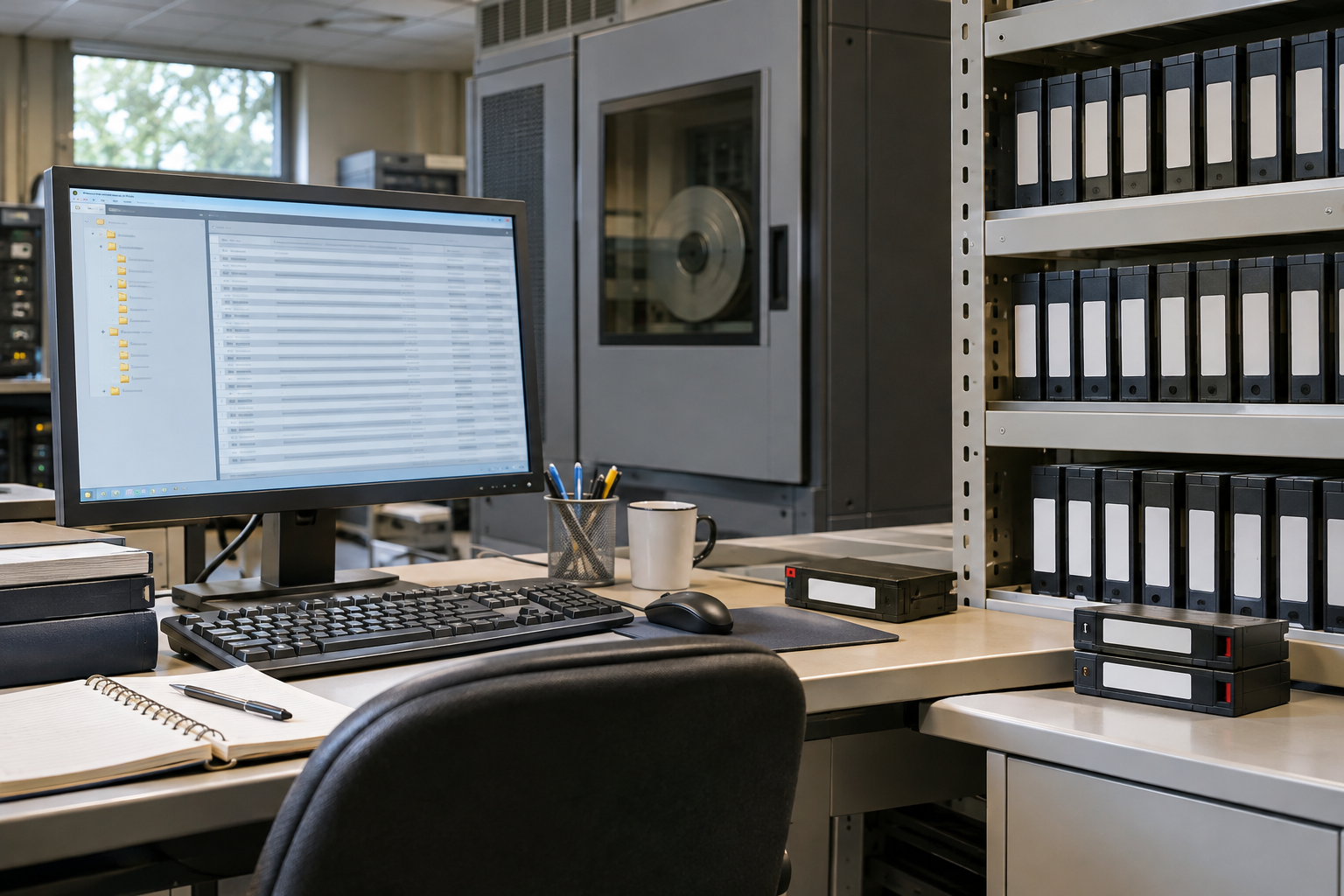
Scientific data can outlive the software and systems originally used to analyze it. Preserving its usefulness means retaining the information needed to understand, reproduce, and extend the original work.
Scientific data can outlive the software and systems originally used to analyze it. Preserving its usefulness means retaining the information needed to understand, reproduce, and extend the original work.
- Data preservation includes software and documentation.
- Versioning connects results with the resources that produced them.
- Reuse requires maintained context as well as intact files.
Preserving a Measurement’s Meaning
A stored file can remain readable while becoming scientifically difficult to use.
Researchers may also need the detector configuration, calibration information, software version, selection rules, and assumptions associated with that file. Losing those connections can make a calculation impossible to reproduce even when the original bytes survive.
CERN identifies changing formats and access tools as an ongoing preservation challenge and participates in the Data Preservation in High Energy Physics collaboration.
Publishing Data With Its Supporting Resources
The CERN Open Data portal provides datasets alongside accompanying software and documentation. Its records use persistent identifiers, including DOIs, to support citation.
The portal describes several levels of preserved information, ranging from supporting material for published results to reconstructed datasets and resources needed for more extensive analysis. Availability depends on the experiment and release.
These distinctions help users understand what a release allows them to do. A simplified educational dataset and a reconstruction-level scientific release serve different purposes.
Software Environments Need Attention Too
An analysis can depend on libraries, operating-system behavior, and external services.
Preserving an executable environment can make reuse easier, but that environment also needs to be documented and checked over time. A stored software package is useful only while researchers can run it or translate its behavior into a maintained system.
A practical preservation test is to rerun a known analysis and compare the output with a documented reference.
That test connects storage integrity with scientific reproducibility. It checks whether the preserved collection still performs its intended role.
Planning Starts Before the Final Publication
CERN’s Open Science Office describes research data management as work extending from collection and processing through publication and long-term preservation.
It encourages planning throughout the research process, rather than treating archiving as a final administrative step.
Early planning makes it easier to capture information while the people and systems that created it remain available.
For future researchers, the result is more than an archive of past conclusions. It is a maintained body of evidence that can support new comparisons, revised techniques, and questions the original investigators did not pursue.
Sources: CERN data preservation; CERN Open Data portal documentation; CERN research data management.
Explore Embedded Science or support our reporting. Purchases do not automatically renew.