ADVERTISE WITH USReach Embedded Science readers →
Searching for Two Higgs Bosons in One Collision
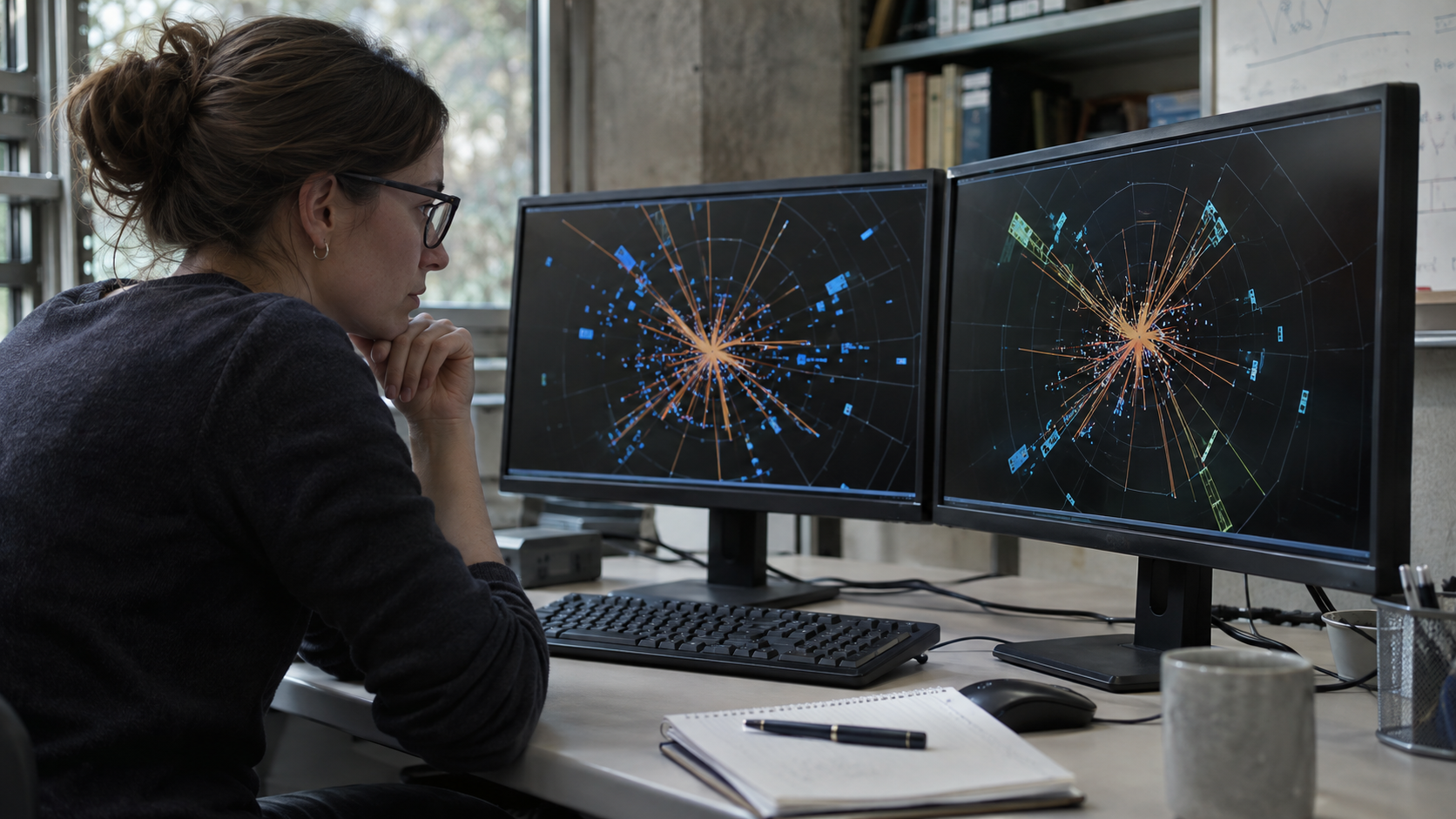
Producing two Higgs bosons in the same collision offers a way to investigate how the Higgs interacts with itself. CMS is using improved analysis methods, including neural networks, to search for this rare process.
Producing two Higgs bosons in the same collision offers a way to investigate how the Higgs interacts with itself. CMS is using improved analysis methods, including neural networks, to search for this rare process.
- The search reconstructs particular Higgs decay products.
- Neural networks help distinguish candidate events from background.
- The reported result sets limits without claiming a significant excess.
A Direct Route to Higgs Self-Interaction
A particle’s interactions include more than its relationships with other particle types. The Higgs boson’s self- interaction is an important target for experimental study.
Higgs-pair production can probe that interaction, but the process is extremely rare. The experimental challenge combines limited expected signal counts with much more common processes that can create similar measured signatures.
CMS’s November 2026 account describes a search using two charged leptons and two bottom quarks in the final state, based on proton collisions at 13.6 TeV.
Reconstructing the Candidate Process
In the studied channel, one Higgs boson decays into a bottom quark–antiquark pair. The other produces W bosons whose decays yield charged leptons and neutrinos.
The analysis must combine the information available in the detector into an assessment of whether an event resembles the expected signal.
Several physical processes can produce overlapping signatures. The important task is therefore to characterize distributions of events, rather than label every individual candidate with certainty.
Where Neural Networks Help
CMS reports a strategy using three neural networks: an initial categorization network and two specialist networks.
Together with changes to event selection and bottom-quark jet identification, the analysis improved its sensitivity relative to the preceding version after accounting for dataset-size differences.
A network score is an analysis input. Researchers still need a validated description of signal and background, including how uncertainty affects the interpretation of that score.
The gain comes from making more effective use of measured information within a controlled statistical analysis.
Reading the Limit Correctly
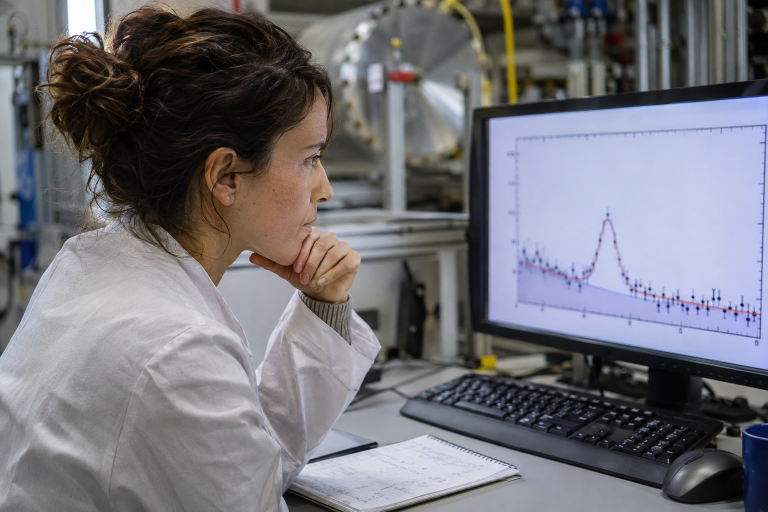
CMS found no significant excess in this search. The analysis places a 95% confidence-level upper limit of 12 times the Standard Model’s predicted production rate. Combining it with earlier CMS results improves the stated limit to 7.9 times that prediction.
These limits describe what the data can constrain under the analysis assumptions. They do not constitute an observation of the predicted process.
The result demonstrates how improved reconstruction and classification can strengthen a search before additional collision data arrive. Future progress will depend on both increased information and continued control of experimental and modeling uncertainties.
Sources: CMS search briefing; research result HIG-25-018; CMS Higgs 2026 results.
Explore Embedded Science or support our reporting. Purchases do not automatically renew.