ADVERTISE WITH USReach Embedded Science readers →
Rebuilding CERN’s Detectors From the Inside Out
Higher collision rates require detectors capable of separating increasingly complex measurements. CERN’s shutdown work combines careful removal of existing equipment with the assembly of new tracking systems.
Higher collision rates require detectors capable of separating increasingly complex measurements. CERN’s shutdown work combines careful removal of existing equipment with the assembly of new tracking systems.
- Existing detector components must be extracted without damaging their surroundings.
- New silicon trackers are being assembled at collaborating institutions.
- Cooling, power, alignment, and data connections are integral to the upgrade.
A Detector Upgrade Is a Coordinated Reconstruction
Tracking detectors measure the paths of charged particles. As collision conditions become more demanding, the detector and its readout systems must provide usable measurements within tighter operational constraints.
The work involves physical access, component removal, new assembly, and extensive checking. It also requires continuity of the records that describe where each component is installed and how it performs.
CERN’s Long Shutdown 3 updates document these activities across the experiments.
Removing a Successful Detector
CMS has extracted its Phase-1 pixel detector after an extended period of operation.
The removal makes room for the next stage of detector development. An upgrade of this kind does not imply that the previous instrument failed; it reflects the requirements of the coming operating environment.
CMS’s account describes a staged extraction process involving the forward sections and the barrel detector.
Dense experimental installations offer limited clearance. Handling equipment, temporary supports, access routes, and protection of surrounding components must all be planned.
Assembling the New Tracking Layers
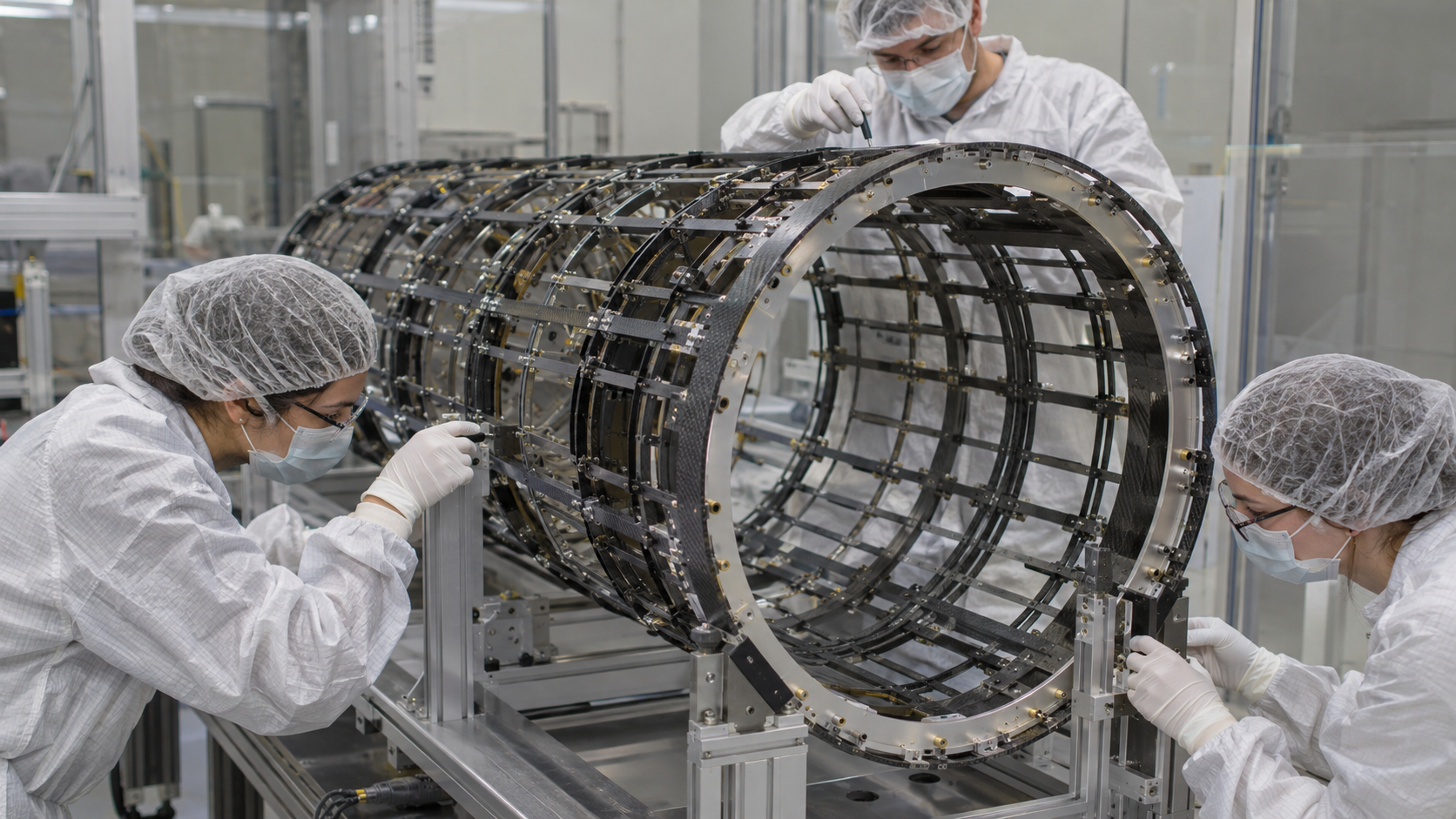
ATLAS reported loading detector modules onto the first production ring of its Inner Tracker Pixel Inner System in October 2026.
The ring combines silicon modules with lightweight supports and the services needed for power, cooling, and data. Initial positioning measurements formed part of the assembly checks.
A tracker is therefore more than its sensing material. The support structure determines geometry, cooling controls operating conditions, and service connections determine whether measurements can be collected reliably.
Alignment Links Construction With Analysis
Reconstructing a particle trajectory depends on knowing where its measured points are located.
That makes alignment information part of the measurement system. Assembly records and later calibration help connect the physical detector to the geometry used by reconstruction software.
An upgrade must consequently establish both mechanical readiness and a validated description of the installed instrument.
The visible construction milestones are important, but successful operation also depends on less visible work: connection testing, calibration procedures, monitoring, and verification that the full chain produces dependable data.
Sources: CERN Long Shutdown 3; CMS pixel-detector extraction; ATLAS Inner Tracker ring assembly.
Explore Embedded Science or purchase a membership. Purchases do not automatically renew.