ADVERTISE WITH USReach Embedded Science readers →
The Magnets Preparing CERN for Its Next Stage
The High-Luminosity LHC needs stronger focusing systems to bring its proton beams into tighter overlap. New superconducting magnets are moving from development and testing toward installation.
The High-Luminosity LHC needs stronger focusing systems to bring its proton beams into tighter overlap. New superconducting magnets are moving from development and testing toward installation.
- CERN reports completion of eight required long quadrupole magnets.
- Niobium–tin technology supports stronger magnetic fields.
- Integrated tests examine the magnets and their supporting systems together.
Focusing Beams More Tightly
An accelerator’s collision energy and its collision rate describe different capabilities.
Focusing magnets help control the beam shape near an interaction point. Bringing the beams into tighter overlap contributes to luminosity, which determines how rapidly experiments can accumulate collision opportunities.
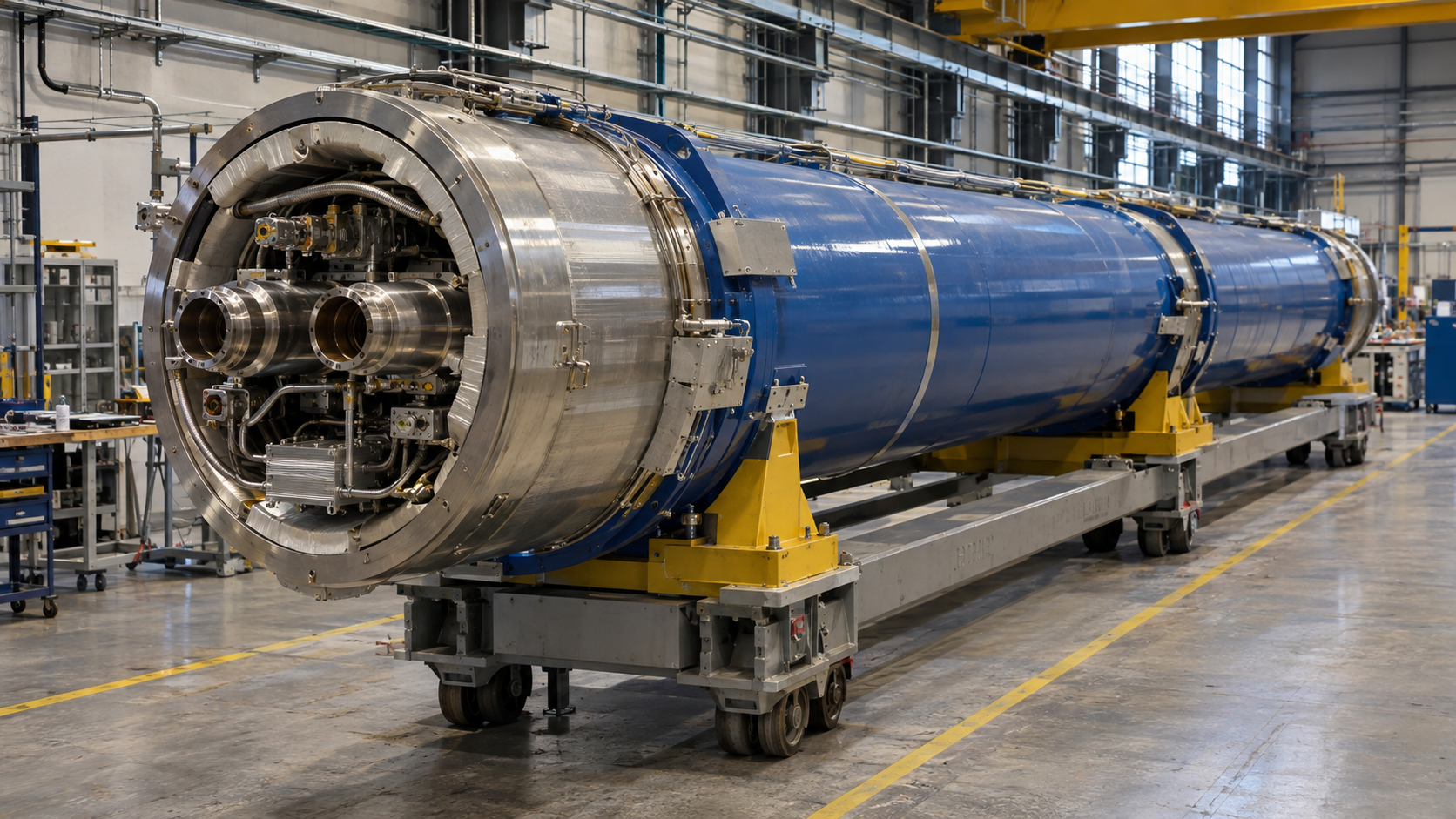
In October 2026, CERN announced that all eight CERN-made long quadrupoles needed for installation were ready, with two spares progressing through their final stages.
The magnets use niobium–tin superconducting technology, have a magnetic length of 7.2 meters, and a nominal peak field of 11.3 tesla.
Scaling a Magnet Changes the Engineering
A long accelerator magnet must maintain the intended field and mechanical behavior across its length.
Coils, supports, manufacturing tolerances, and assembly procedures become part of its performance. A successful short model does not automatically establish that a longer magnet will behave identically.
CERN’s account describes iterative changes to coil fabrication and assembly during development. The completed magnets reflect that extended engineering process.
What Magnet “Memory” Means
Superconducting magnets can undergo training: repeated powering cycles during which mechanical adjustments and associated transitions help the system reach its intended operating conditions.
The ability to retain that trained performance is called memory in this context.
CERN’s full-scale IT String tests brought the inner-triplet magnets to nominal operating current and subsequently powered all 17 electrical circuits to their operating values. The work also tested protection systems and interactions between subsystems.
This terminology describes the magnet’s repeatable operating behavior. It is separate from computer memory or machine learning.
Testing the Infrastructure Together
A superconducting magnet operates within a larger installation that includes power converters, cryogenics, protection, controls, alignment, and vacuum systems.
Integrated testing examines behavior that individual component tests cannot fully establish. It can reveal how a protection action, powering sequence, or temperature condition affects the rest of the installation.
CERN’s readiness announcement describes installation planning as the next stage, with the first relevant magnets expected to enter the tunnel in 2028. That is a planned installation milestone, not a statement that the upgraded collider is already operating.
Sources: CERN magnet-completion announcement; integrated full-power tests; High-Luminosity LHC project.
manufacturing and integrated testing preparing the HiLumi upgrade.
Explore Embedded Science or support independent reporting. Purchases do not automatically renew.