ADVERTISE WITH USReach Embedded Science readers →
Following a Particle’s Wake Through Primordial Matter
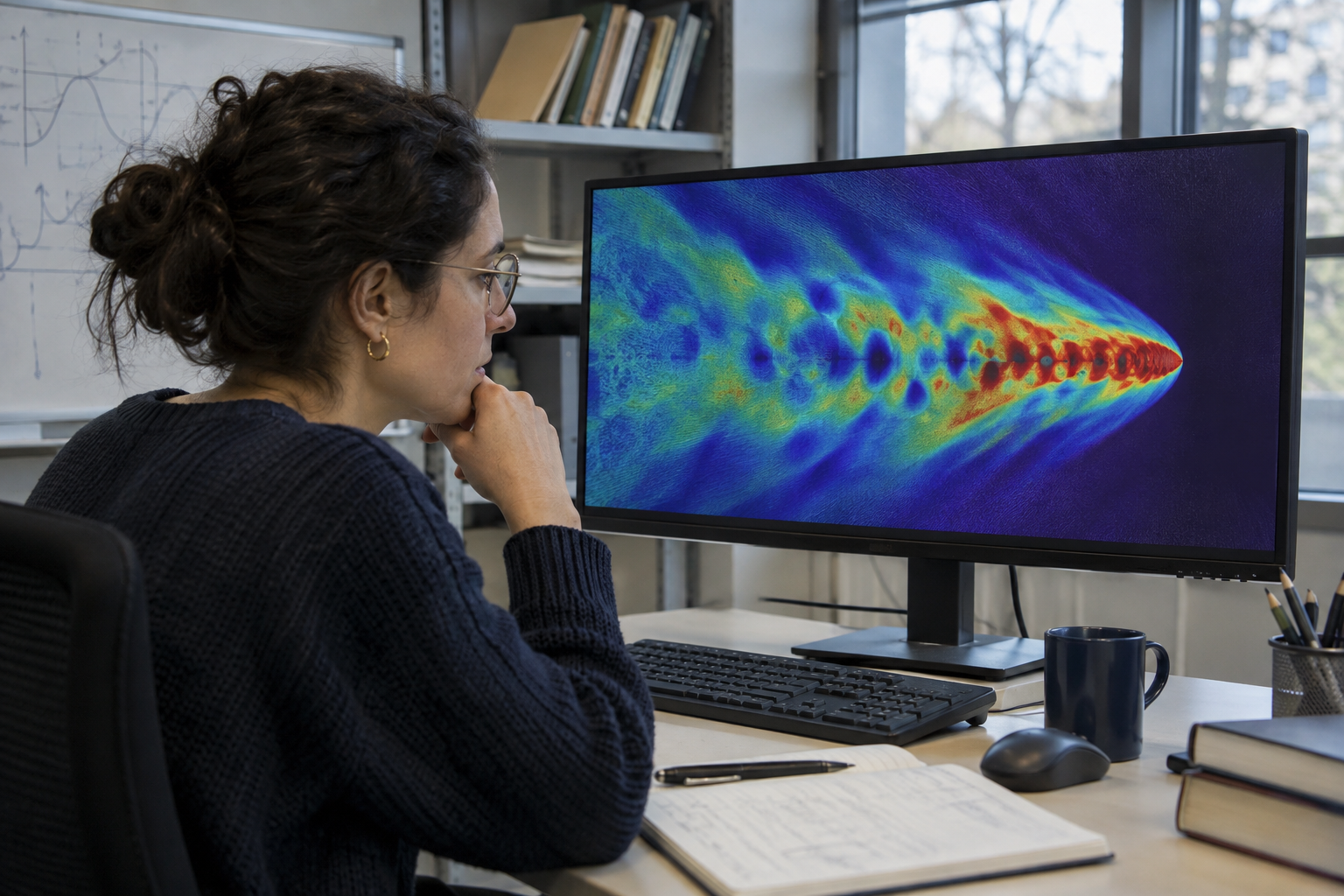
Energetic particles disturb the material through which they travel. CMS researchers have observed a wake associated with partons passing through quark–gluon plasma, providing another way to study this short- lived state of matter.
Energetic particles disturb the material through which they travel. CMS researchers have observed a wake associated with partons passing through quark–gluon plasma, providing another way to study this short- lived state of matter.
- Heavy-ion collisions create conditions for quark–gluon plasma.
- Partons transfer energy and momentum to the surrounding medium.
- Correlations between jets and other particles reveal the medium’s response.
Studying the Response of the Medium
Quark–gluon plasma is a state in which quarks and gluons are not confined within ordinary hadrons. Researchers study it using high-energy collisions of heavy nuclei.
Energetic quarks and gluons, collectively called partons, produce sprays of particles known as jets. Their passage through the plasma transfers energy and momentum to the medium.
CERN’s October 2026 account describes CMS’s direct observation of a wake associated with that interaction.
The measurement extends the question beyond how a jet changes. It also examines how the surrounding material responds.
Why Opposing Jets Are Useful
The analysis uses pairs of jets traveling in approximately opposite directions.
That geometry provides information for distinguishing the expected wake from other effects associated with jets and the underlying collision. CMS reports a depletion of particles behind the jet direction consistent with the predicted wake behavior.
The collaboration also examined how the signal changes with the degree of overlap between the colliding nuclei. Stronger wake signals appeared in conditions producing more plasma.
The Boat Comparison Has Limits
A boat’s wake is a useful everyday analogy for a moving object disturbing a medium. The experimental measurement, however, is built from particle distributions and correlations.
It is not a photograph of a tiny boat-shaped disturbance inside a collision. Researchers infer the relevant behavior from reconstructed events and statistical comparisons.
That distinction matters because the medium exists briefly and cannot be examined as an ordinary sample in a container.
The analysis must separate the signal of interest from the many other particles and collective effects present in heavy-ion collisions.
Connecting Energy Loss With Energy Redistribution
A jet can lose energy to the medium, but understanding the plasma also requires examining where that transferred energy and momentum appear.
Wake measurements provide a way to test descriptions of that response. Comparing the measured distributions with theoretical calculations can help distinguish how different models treat the interaction.
The result therefore contributes an additional observable to the study of quark–gluon plasma. Its scientific value lies in the quantitative pattern, its dependence on collision conditions, and the ability of theoretical descriptions to reproduce it.
Sources: CERN’s wake announcement; CMS account; research result HIN-25-012.
Explore Embedded Science or purchase a membership. Purchases do not automatically renew.