ADVERTISE WITH USReach Embedded Science readers →
Why Ferroelectric Memory Matters for Small AI Devices
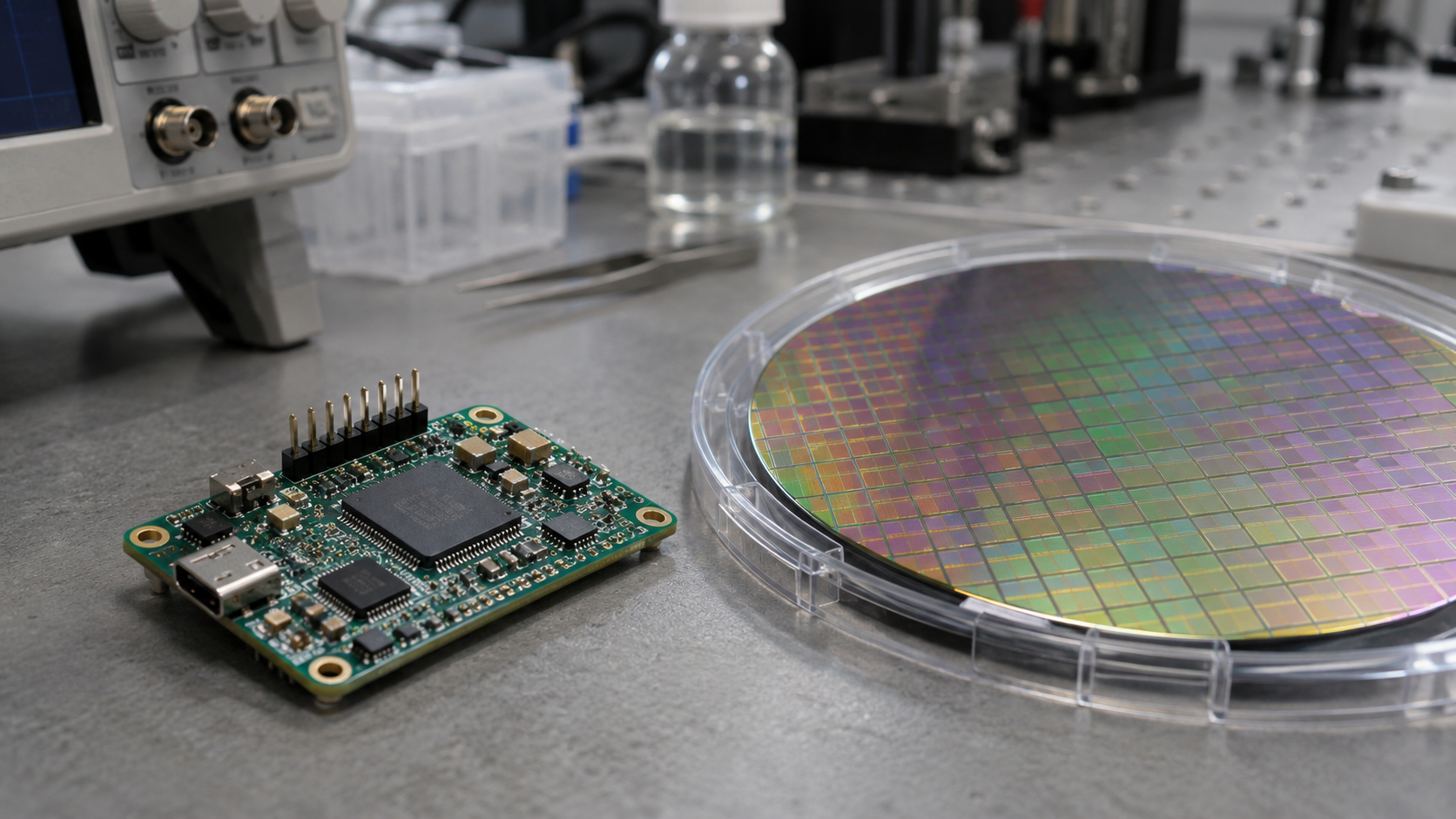
Small AI systems need memory that fits their space and power budgets. CEA-Leti’s research addresses both memory density and the challenge of retaining or updating information efficiently.
Small AI systems need memory that fits their space and power budgets. CEA-Leti’s research addresses both memory density and the challenge of retaining or updating information efficiently.
- Ferroelectric memory retains stored information without continuous power.
- A vertical capacitor design reduces the footprint of individual memory cells.
- Separate hybrid-memory research supports local learning and inference.
Memory Is Part of the Computing Budget
An embedded AI device needs somewhere to keep its model parameters, intermediate calculations, and operating state. The processor’s arithmetic capability matters, but its usefulness also depends on how much information can remain nearby.
For a battery-powered sensor, retained information can be particularly valuable between periods of activity. If model parameters remain stored while parts of the system are powered down, the device has more options for managing its energy.
That does not make the whole device power-free during standby. Communications, monitoring circuits, and other components still have their own requirements. Nonvolatile memory addresses one part of that larger design.
Building Capacitors Upward
CEA-Leti announced a 22-nanometer FeRAM demonstration in June 2026. Its architecture vertically integrates ferroelectric capacitors made with hafnium zirconium oxide.
According to the institute, the demonstrated cells occupy 2.5 times less area than standard SRAM cells at the same manufacturing node. The approach addresses a density limitation associated with planar capacitor structures. These are memory-cell comparisons, rather than measurements of an entire AI device’s size or energy consumption.
Vertical construction changes how much useful capacitor structure can fit within a given horizontal footprint. That is important because shrinking a memory cell involves more than making its selection transistor smaller.
Retaining Weights and Updating Them
Another CEA-Leti-led project combines ferroelectric capacitors with memristors. The two technologies have different strengths, allowing the architecture to divide responsibilities between precise weight updates and the representation used during computation.
The researchers demonstrated their hybrid approach on an array containing 18,432 devices fabricated using 130-nanometer CMOS technology. This is a separate research result from the 22-nanometer FeRAM announcement.
The distinction matters. A denser nonvolatile memory and a memory arrangement designed for local training solve related but different problems.
What a Useful Device Test Would Measure
An application-level evaluation would include read and write energy, retention, endurance, access time, and the surrounding control circuitry. It would also measure whether the complete device produces acceptable AI results.
For systems that update their models, the frequency and precision of those updates become additional requirements. A device storing an unchanged model has a different workload from one repeatedly learning from new observations.
Manufacturing integration is also progressing through collaborative work. CEA-Leti and Fraunhofer IPMS have reported wafer exchanges involving ferroelectric memory materials within the FAMES pilot line. Such work addresses the practical transfer of materials and processes between facilities.
Sources: CEA-Leti’s 22nm FeRAM announcement; hybrid-memory research; Fraunhofer’s FAMES update.
Explore Embedded Science or support our reporting with a membership. Purchases do not automatically renew.