ADVERTISE WITH USReach Embedded Science readers →
Automotive EECS Highlights: Engineering AI Toward Guided Autonomy
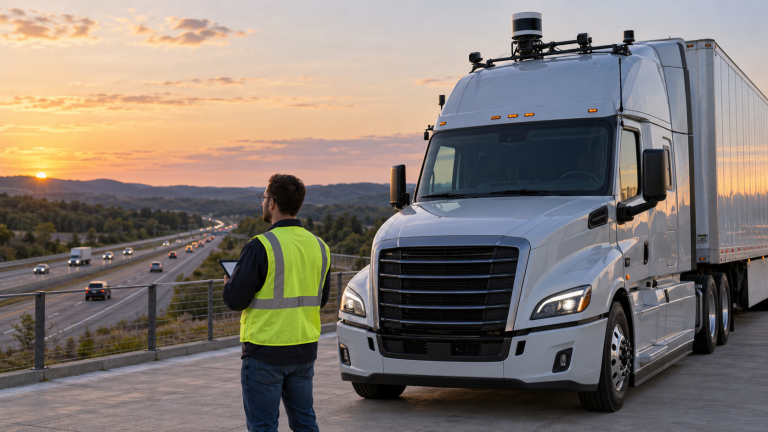
Automotive AI is advancing through better sensing, centralized processors and software architectures that connect machine learning with explicit safety controls. Recent first-party announcements reveal both continuing ambitions for higher automation and a practical emphasis on defined responsibilities, monitored drivers and constrained operation.
- New automotive platforms combine AI compute with separate safety mechanisms and operating limits.
- Radar, cabin sensing and integrated processors address different parts of the control problem.
- Guided autonomy is an editorial description of constrained operation, not a new SAE level.
Stephen A. Vicinanza | Editor, Embedded Science
A trend that needs careful wording
There is no single industry-wide withdrawal from autonomous driving. Suppliers are simultaneously developing supervised assistance, conditional automation and driverless services. What the sources support is a stronger emphasis on the engineering around behavior: where a function may operate, who supervises it and how the vehicle responds when a component or assumption fails.
Calling this guided autonomy can be useful if its meaning stays explicit. Guidance may come from driver supervision, maps, operational restrictions, formal safety rules or a separate safety controller. These are different mechanisms. None should be presented as proof that a vehicle can drive everywhere or that a human is always available to rescue it.
Mercedes-Benz and NVIDIA extend their architecture
On October 16, Mercedes-Benz and NVIDIA announced an expanded partnership combining MB.OS with NVIDIA Hyperion computing and sensing, Alpamayo Stack software and Halos safety technology. The release describes a parallel safety stack providing redundancy and guardrails alongside AI driving software.
The announcement spans advanced assistance and development of future Level 4 applications. It is therefore a development direction, not evidence that every Mercedes-Benz has acquired driverless capability. The architectural point is relevant now: increasingly capable AI is being paired with a broader safety foundation rather than treated as sufficient by itself.
Source: NVIDIA and Mercedes-Benz: October 16 partnership announcement
Mobileye consolidates supervised highway functions
Mobileye's January 2026 Surround ADAS announcement describes processing multiple cameras and radars on one EyeQ6H and one electronic control unit. The company identifies hands-free, eyes-on operation on designated highways, including lane changes and traffic-jam assistance within specified conditions.
Consolidation can simplify wiring and integration, but it also makes workload separation and failure management more important. A central processor handling perception, parking and assistance must preserve the timing and availability required by each function. Hands-free convenience does not change the driver's obligation to monitor a Level 2 system.
Source: Mobileye: Surround ADAS architecture and supervision
Imaging radar targets difficult highway perception
Mobileye's May 2025 imaging-radar announcement describes a customer program targeting Level 3 highway automation starting in 2028. Its digital signal-processing architecture and dedicated radio-frequency chips are intended to complement cameras and improve perception in difficult lighting, weather and clutter.
That future production date must remain attached to the claim. The engineering significance is the attempt to provide an additional sensing channel with different failure characteristics. More sensor data is useful only when the system can evaluate its quality and preserve safe behavior when measurements disagree.
Source: Mobileye: Imaging radar selection and 2028 production target
ST strengthens the view inside the cabin
STMicroelectronics introduced the SafeSense VD56GA infrared automotive image sensor on September 14. The 1.1-megapixel device targets driver and occupant monitoring, with integrated image-processing functions intended to reduce camera-module complexity and system cost.
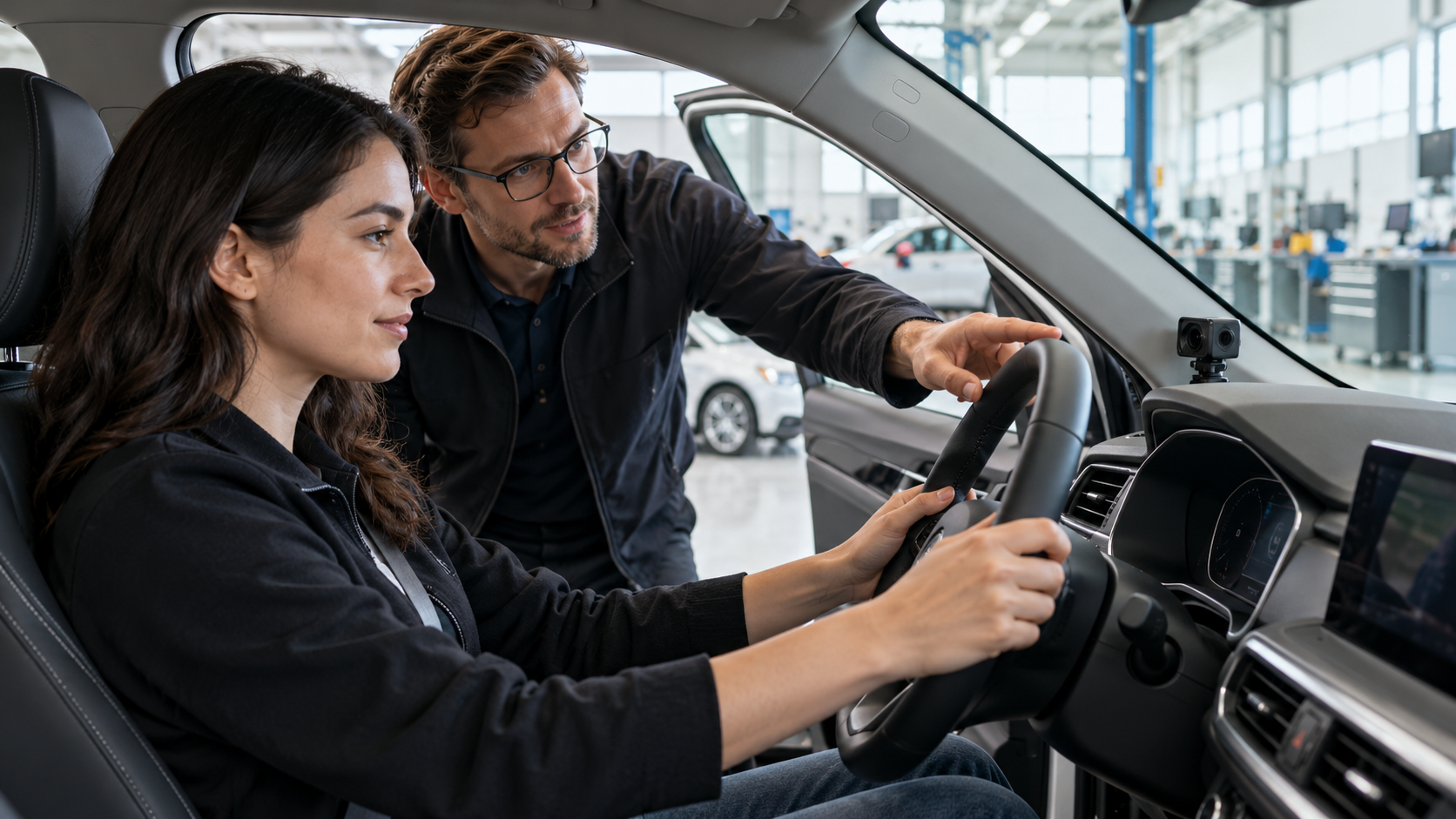
Cabin sensing closes an important gap between an assistance feature and its human supervisor. The vehicle needs evidence that the person expected to supervise is attentive, rather than an assumption based on the driver's seat being occupied. A camera alone cannot guarantee readiness; the complete monitoring algorithm, alerts and escalation strategy still require validation.
Source: STMicroelectronics: SafeSense VD56GA in-cabin sensing
NXP moves intelligence into the vehicle core
NXP's January S32N7 announcement describes centralizing propulsion, vehicle dynamics, body, gateway and safety functions. The series combines application and real-time computing with networking, hardware isolation, security and AI acceleration; Bosch is identified as an early integration partner.
This matters because automotive intelligence extends beyond a driving-policy model. Predictive maintenance, data routing and coordinated vehicle functions depend on reliable access to signals throughout the electrical architecture. Centralization must preserve isolation: a noncritical application should not interfere with a safety-related control loop simply because both share computing resources.
Source: NXP: S32N7 vehicle integration platform
Displays and communication remain part of control
Infineon's October 6 TRAVEO CYT4EN announcement focuses on automotive instrument clusters, supporting external LPDDR4 memory, Full HD displays and two simultaneous screens. It is a graphics-controller development, not an autonomous-driving processor announcement.
Its relevance is the interface between electronics and responsibility. An automated function should communicate availability, limitations and requests for intervention clearly. Attractive graphics cannot replace validated control logic, but an ambiguous display can undermine an otherwise carefully specified assistance system.
Source: Infineon: TRAVEO CYT4EN cockpit graphics
How to evaluate the announcements together
These developments sit at different layers of the vehicle, so their specifications should not be combined into an imaginary finished product. A cabin sensor, graphics MCU and central processor may serve different programs with different release schedules. Their relevance is the set of engineering problems they reveal, not an assumption that they already operate together.
A useful comparison starts with authority. Does a feature merely warn, provide supervised steering, or perform the driving task within a defined domain? Next comes evidence: was the capability demonstrated, sampled with customers, selected for future production or deployed commercially? Finally comes fallback: what happens when the system cannot maintain its specified performance?
Software updates deserve the same discipline. Adding a feature can change compute utilization, network traffic, sensor interpretation and the information presented to the driver. A credible update process therefore evaluates interactions with existing functions and maintains configuration records. More frequent updates do not automatically imply safer behavior.
The industry can pursue more capable learning systems while retaining explicit boundaries. That combination is more informative than a simple contest between behavioral learning and programmed rules. Both must be judged within the complete vehicle architecture.
Formal rules give behavior an enforceable boundary
Mobileye's Responsibility-Sensitive Safety methodology formalizes safe distances and appropriate responses under explicit assumptions. This illustrates a useful distinction between predicting what another driver will probably do and maintaining a safety margin when that prediction is wrong.
Bosch likewise describes interior sensing and clearer human-machine interaction as part of assisted-driving development. Together, these approaches support a grounded editorial conclusion: the valuable trend is toward specified, inspectable control arrangements. Performance demonstrations should be accompanied by operating conditions, validation evidence and a clear allocation of human and machine responsibilities.
Source: Mobileye: Safety methodology and RSS
Source: Bosch: Assisted driving and interior sensing
Subscribe to Embedded Science for EECS research and automotive engineering updates. Follow Embedded Science on LinkedIn and WordPress for continuing coverage of AI, electronics and accountable automation.