ADVERTISE WITH USReach Embedded Science readers →
AI in Automotive: The Electronics Bringing Automated Vehicles to Highway Speed
Automated vehicles are moving beyond controlled yards and into highway freight operations, where speed makes every sensing, computing and braking decision consequential. The engineering story is less about a vehicle behaving independently than about electronics keeping its actions inside a demonstrable operating envelope.
- Highway automation demands long-range sensing, timely computation and redundant vehicle controls.
- Driverless freight and supervised passenger-car assistance carry fundamentally different responsibilities.
- Guided autonomy means enforceable operating limits, validated fallback behavior and accountable oversight.
Stephen A. Vicinanza | Editor, Embedded Science
From industrial AGVs to public-road automation
The abbreviation AGV usually describes an automated guided vehicle used in industrial material handling. For highway-speed trucks and cars, automated vehicle or automated driving system is more precise. The distinction matters: a warehouse route can be segregated and tightly controlled, while a public highway introduces unpredictable traffic, debris, construction and changing visibility.
At 65 mph, a vehicle travels approximately 29 meters every second. A tenth of a second therefore represents almost three meters of movement before any additional braking distance is considered. This simple calculation explains why perception range, communication delays and execution timing belong in the same engineering discussion.
Source: NHTSA: Automated Vehicle Safety
Commercial deployment is becoming concrete
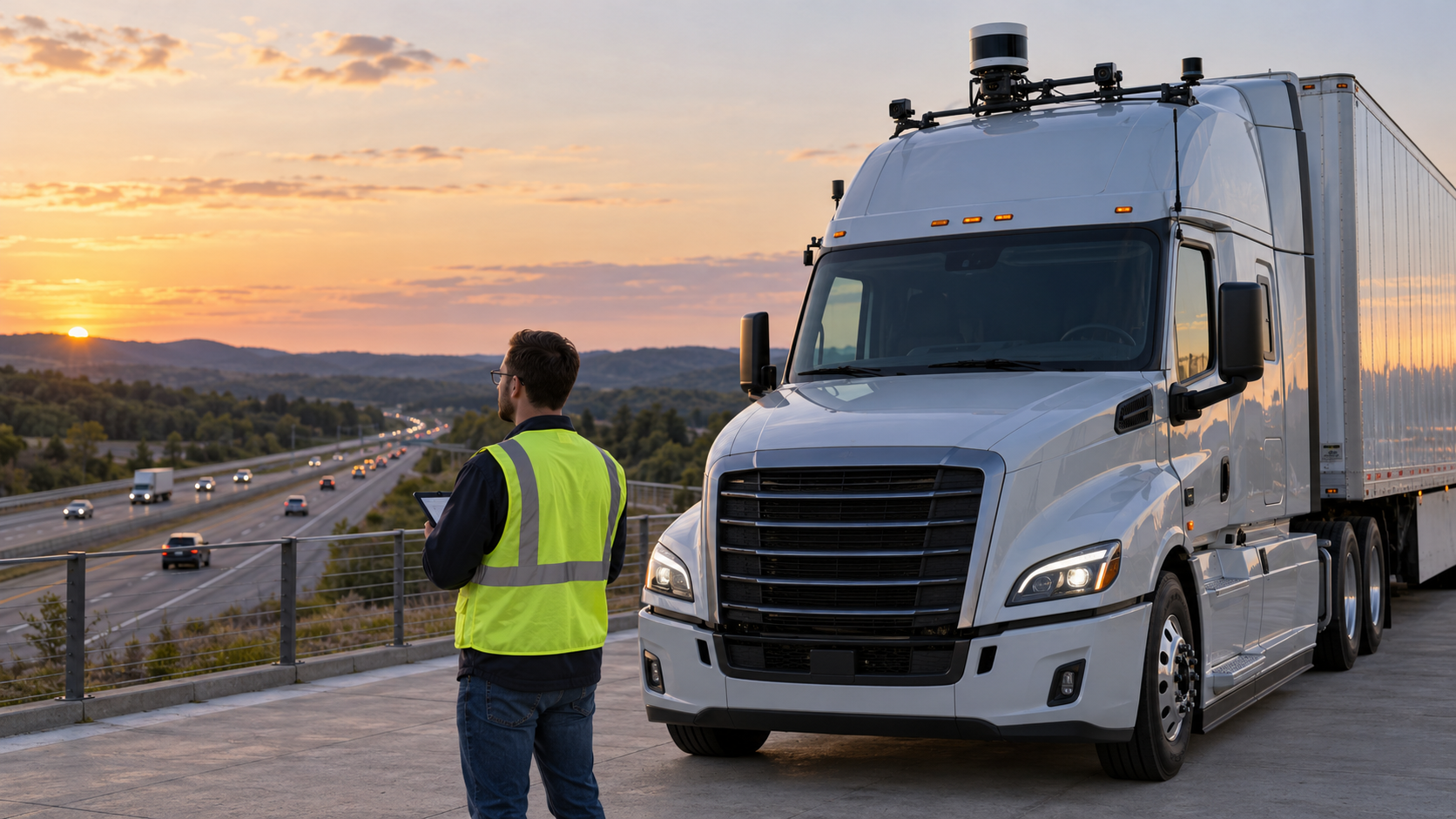
Aurora announced its second-generation driverless trucks on July 22, 2026. The company described an International LT-based platform, next-generation hardware and a commercial network encompassing ten driverless routes across the United States Sun Belt. It also reported nearly 440,000 driverless miles through June. Those figures describe Aurora's reported deployment, not universal permission for automated trucking everywhere.
Aurora says Roush integrates redundant systems and its autonomous hardware during an established upfit process. This shifts attention from a successful demonstration to repeatable manufacturing: connectors, installation tolerances, electrical interfaces, inspection and configuration control must remain consistent across vehicles.
Source: Aurora: Second-generation driverless truck launch
Highway speed changes the sensing problem
A vehicle must detect a hazard early enough to classify it, estimate motion, select a response and execute that response with adequate margin. Cameras, radar and lidar contribute different measurements; combining them does not automatically remove uncertainty. Their data must be synchronized, calibrated and checked for disagreement.
In its earlier technical explanation, Aurora described FirstLight lidar detecting objects beyond 450 meters. The same explanation distinguished its Level 4 system from driver assistance and described a secondary fallback computer. Detection range is a component claim, however, not proof that every object will be identified at that distance in every weather condition.
Source: Aurora: Sensors, fallback and operating responsibilities
Redundancy must reach the physical vehicle
Torc's production-development account describes an October 2024 driverless acceptance test at speeds up to 65 mph on a closed multilane track. That is a significant highway-speed validation milestone, but it must not be mistaken for unrestricted commercial operation on public roads.
The same account describes the autonomous-ready Freightliner Cascadia and electronically controlled redundant systems. The engineering lesson is that an AI computer cannot compensate for losing the only available steering actuator or electrical supply. Backup computing, power distribution and actuation must work together, with faults detected before they defeat the fallback path.
Source: Torc: Production-intent embedded hardware and validation
Failure handling is part of the driving task
Aurora's July platform explanation identifies redundancy in braking, steering and power distribution. It says the system is designed to pull over autonomously when an issue occurs and describes roadside assistance as a separate operational function. A support worker is not automatically a safety driver.
That separation is essential. A remote supervisor may help interpret an unusual situation, but network availability cannot substitute for onboard control capable of handling an immediate fault. Engineers must specify what happens during sensor degradation, compute failure or a communications interruption, including the conditions under which a trip cannot continue.
Source: Aurora: Latest launch questions and vehicle redundancies
Evidence must accompany every capability claim
Aurora publishes a safety-case framework covering nominal operation, organizational processes and resilience to foreseeable events. A safety case organizes claims, arguments and supporting evidence; its existence alone does not establish that every driving situation has been solved.
Aurora also reported commissioning an assessment by Edge Case that reviewed the overall safety-case structure and sampled supporting claims. That description matters: a commissioned assessment with selected evidence is not blanket certification of all routes, weather conditions or future software. Review scope should remain visible whenever safety results are communicated.
Source: Aurora: Public Safety Case Framework
Source: Aurora and Edge Case: Assessment scope
What highway electronics must prove
Consider a truck approaching roadworks while a camera becomes obscured. The engineering question is not simply whether the model recognizes orange cones. The system must determine whether its remaining sensing supports the planned speed, whether the lane geometry still matches its assumptions and whether a safe stopping location is reachable. Each decision consumes part of the available time and distance.
This is why average performance is an incomplete specification. Designers need timing budgets for data acquisition, inference, planning, communication and actuation, plus evidence about difficult cases. A fast average response can coexist with occasional delays that consume the entire safety margin. Thermal throttling, overloaded networks and stale measurements deserve attention alongside model accuracy.
Electrical robustness also belongs in the autonomy story. A voltage disturbance, damaged connector or cooling failure can become a control problem if it disables several supposedly independent functions together. Redundancy should therefore be evaluated for shared dependencies, rather than counted as a second copy of a component.
For buyers and fleet operators, useful questions are concrete: which failures are detected, which functions remain available, and what evidence supports the response? These questions connect software claims to the physical machine carrying freight beside other road users. They also make comparisons between competing systems more informative than a leaderboard built around computing throughput alone. Those conditions should be documented clearly.
Guided autonomy is an engineering discipline
Here, guided autonomy means a system constrained by approved routes, operating conditions, safety rules and fallback requirements. It does not mean that every highway vehicle is remotely steered, nor does it establish a new SAE automation level. Level 2 assistance still requires continuous human supervision; Level 4 automation must manage its driving task and fallback within its defined domain.
The practical advance is therefore measurable authority. Designers should explain which roads are supported, how degraded sensing changes behavior, when dispatch must refuse a journey and who can suspend operations. Highway automation becomes credible when a vehicle can recognize the limits of its validated capability and respond safely, not merely demonstrate persuasive driving behavior.
Source: Mobileye: Supervised highway assistance and defined conditions
Subscribe to Embedded Science for automotive electronics, AI and computing research. Follow Embedded Science on LinkedIn and WordPress for the next engineering update.