ADVERTISE WITH USReach Embedded Science readers →
What an Exceptionally Rare Particle Decay Reveals
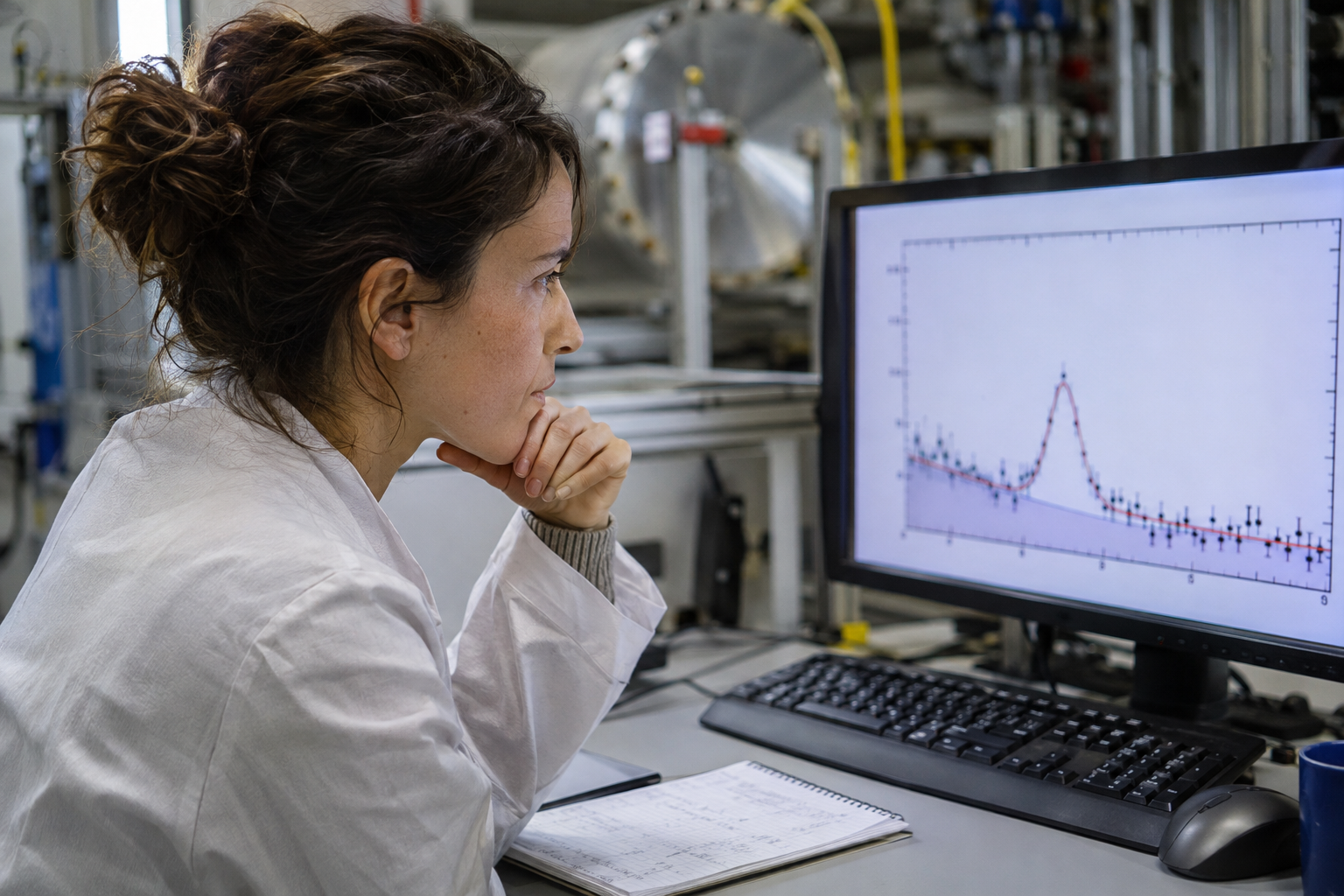
LHCb has reported evidence for a beauty-particle decay predicted to occur extraordinarily infrequently. Measuring such processes helps researchers test whether established physics remains accurate in situations sensitive to additional particles.
LHCb has reported evidence for a beauty-particle decay predicted to occur extraordinarily infrequently. Measuring such processes helps researchers test whether established physics remains accurate in situations sensitive to additional particles.
- The reported process produces a pair of muons.
- Its measured significance supports evidence, below the observation threshold.
- Agreement with predictions constrains possible extensions to established physics.
A Small Signal With a Large Background
The process involves a neutral beauty meson, B⁰, decaying into a muon and an antimuon.
CERN’s November 3, 2026 announcement describes the expected rarity as approximately one in ten billion relevant decays. That comparison concerns the particle’s decay probability, rather than the fraction of every proton collision recorded at the LHC.
The result is consistent with Standard Model predictions. Its importance lies in testing those predictions in an unusually sensitive channel.
Why Rarity Can Increase Sensitivity
A measured process can be influenced by quantum contributions involving particles other than its directly observed products.
For a strongly suppressed decay, additional contributions can change a very small predicted rate in a measurable way. This gives rare-decay measurements a role alongside direct searches for newly produced particles.
A deviation would need careful examination of both the theoretical prediction and the experimental measurement. Agreement is informative too: it limits how much additional contributions can alter the process.
The test therefore remains useful even when it strengthens confidence in the existing description.
Evidence and Observation Have Different Thresholds
LHCb reports a significance of three standard deviations using its newer dataset. Combining that information with earlier data raises the significance to 3.2 standard deviations.
Particle physics conventionally uses five standard deviations as the threshold for claiming an observation of this kind. The present result is consequently described as evidence.
Statistical significance concerns how the measurements compare with a specified background hypothesis. It should not be read as a direct probability that an entire physical theory is true or false.
How Better Detectors Change the Search
CERN attributes progress to increased data collection, improved particle discrimination, and machine- learning techniques that help suppress background.
These improvements work together. Recording more events is valuable only if the analysis can identify the relevant candidates and characterize the remaining background reliably.
Further data can strengthen the measurement and help determine whether the evidence reaches the observation threshold. That progression would establish the decay more firmly while sharpening the test of its predicted rate.
Sources: CERN announcement; LHCb research account; INFN account.
Explore Embedded Science or support independent reporting. Purchases do not automatically renew.