ADVERTISE WITH USReach Embedded Science readers →
What CERN and Mistral Plan for Scientific AI
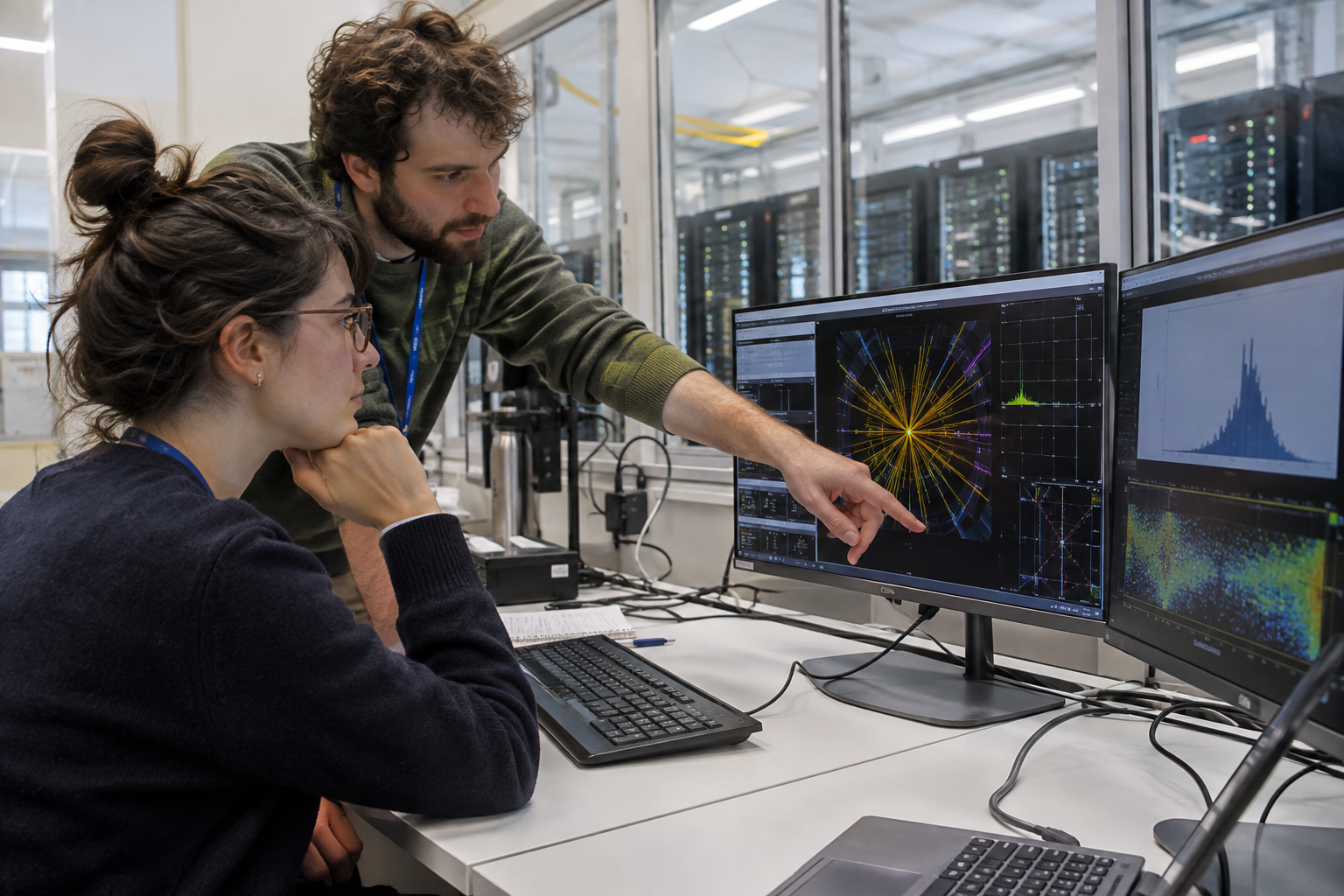
CERN and Mistral are planning foundation models for scientific research. Their initial focus is a shared model that can support several tasks involved in understanding particle collisions.
CERN and Mistral are planning foundation models for scientific research. Their initial focus is a shared model that can support several tasks involved in understanding particle collisions.
- The partnership begins with high-energy physics.
- Simulated collisions provide structured training examples.
- Scientific usefulness requires validation against experimental measurements.
One Model, Several Scientific Tasks
On October 15, 2026, CERN and Mistral signed a statement of intent for a long-term strategic partnership.
Their stated ambition includes a pretrained Large Physics Model trained on billions of simulated proton– proton collisions. Intended applications include collision reconstruction, particle identification, unusual- signal detection, and evaluation of detector designs.
The announcement describes planned development. It does not establish that a finished model has already demonstrated all those capabilities.
Why Shared Representations Could Help
A collision-analysis system performs several connected tasks. Each draws information from measurements that describe the same underlying event.
A foundation-model approach investigates whether useful patterns can be learned once and adapted across those tasks. That could change how researchers organize the reconstruction process and reuse information between its stages.
The engineering question is whether the shared approach produces reliable results across the tasks that matter, including cases that differ from the most common training examples.
A model that performs well on one familiar reconstruction task would still need separate evaluation before taking on another.
Simulation Offers Labels and Introduces Questions
Simulation is useful because researchers can connect generated detector responses to the modeled processes that produced them.
However, a simulated detector is a model of an instrument. Measurements from the physical detector can include conditions and effects that are incompletely represented in that simulation.
An evaluation would therefore need to examine how performance changes between simulated and experimental data. Calibration, uncertainty, and unusual event characteristics belong in that assessment.
For anomaly searches, the definition of an unexpected signal is particularly important. Researchers need to know whether the method retains sensitivity to events outside familiar examples.
Reproducibility Is Part of Scientific Performance
A useful scientific model needs a documented evaluation process. Other researchers must be able to identify the data, model version, assumptions, and analysis that produced a result.
CERN’s computing activities and open-data services provide relevant infrastructure and experience in sharing scientific resources, software, and documentation.
The partnership’s progress will be demonstrated through measured task performance, transparent uncertainty treatment, and reproducible comparisons. Model size and training volume describe resources used; they do not replace those tests.
Sources: CERN–Mistral announcement; CERN computing; CERN Open Data documentation.
Explore Embedded Science or purchase a membership. Purchases do not automatically renew.