ADVERTISE WITH USReach Embedded Science readers →
How AI Helps Reconstruct Particle Collisions
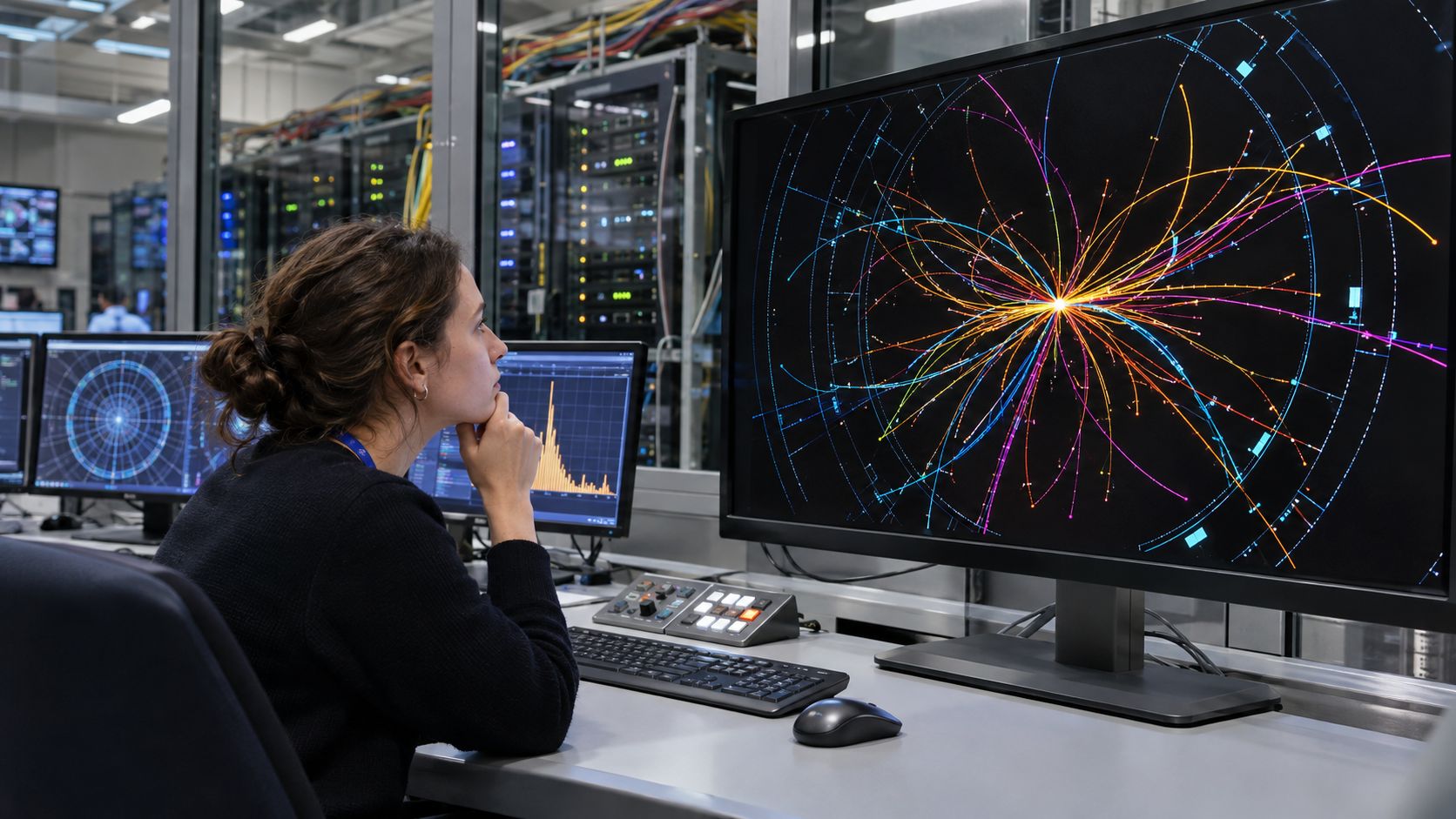
CERN’s ALICE experiment uses machine learning to turn complex detector signals into information researchers can analyze. Neural networks are helping reconstruct particle signals and accelerate selected simulations, with performance checked against both simulated and experimental data.
CERN’s ALICE experiment uses machine learning to turn complex detector signals into information researchers can analyze. Neural networks are helping reconstruct particle signals and accelerate selected simulations, with performance checked against both simulated and experimental data.
- Neural networks help separate useful detector signals from background.
- GPU processing supports reconstruction during data collection and afterward.
- Faster processing must preserve the measurements needed for physics research.
Turning Detector Signals Into Particle Tracks
A particle collision produces measurements that require several stages of interpretation. Reconstructing those measurements means working backward from detector signals to an account of the particles that produced them.
ALICE studies proton and heavy-ion collisions at CERN’s Large Hadron Collider. According to the collaboration, head-on heavy-ion collisions can produce thousands of particles simultaneously. Their overlapping signals create a demanding reconstruction problem.
In October 2025, ALICE first deployed a neural-network algorithm for real-time processing in the experiment. Its task was cluster reconstruction in the Time Projection Chamber, or TPC: identifying small groups of detector signals that become inputs for particle tracking.
This is a specific, bounded application of AI. The network contributes to a processing chain whose output must remain suitable for scientific measurement.
Why Overlapping Signals Are Difficult
Consider an illustrative problem involving several footprints crossing on a muddy path. Some impressions are separate, while others overlap. Reconstructing each person’s route requires deciding which marks belong together and where one impression obscures another.
Particle reconstruction presents a more quantitative version of that association problem. The computer must distinguish individual contributions using measured information.
Two kinds of mistake matter. Combining signals that should remain separate can distort the reconstruction. Separating signals incorrectly can create misleading fragments.
This explains why processing speed alone cannot establish success. A faster algorithm must also preserve the information that later stages need to assemble reliable tracks.
Two Networks Address Different Questions
A doctoral thesis by Christian Hans-Jörg Sonnabend, available through CERN’s repository, describes two neural networks for TPC cluster reconstruction.
One is a classification network, aimed at reducing the cluster count and improving processing in dense tracking environments. The other is a regression network, designed to separate overlapping charge contributions and determine cluster properties.
Classification assigns a category or score. Regression estimates numerical quantities. In this application, those are complementary jobs: deciding which signals to retain and estimating their characteristics accurately.
The thesis evaluates the methods in simulation and validates them on reconstructed lead–lead collision data. It reports cluster reductions of up to 18% under the studied conditions, alongside improved track-fit quality and maintained particle-identification performance. That percentage concerns clusters in the evaluated reconstruction, rather than the experiment’s entire stored dataset.
Why Reducing the Cluster Count Can Help
The consequence of a cluster decision extends beyond that individual decision. Retained information becomes input for subsequent reconstruction.
As an illustrative example, imagine a later processing stage that compares candidate measurements to decide whether they belong to the same path. Removing irrelevant candidates earlier can reduce the work presented to that stage.
However, discarding useful measurements can also weaken the result. A reduction target therefore needs a corresponding quality requirement.
The thesis’s combination of cluster-count measurements, track-fit evaluation, and particle-identification checks addresses that distinction. It evaluates what remains scientifically usable, rather than treating a smaller output as sufficient evidence of improvement.
GPUs Support More Than Neural Networks
ALICE’s computing infrastructure also demonstrates why GPU acceleration and AI should be described separately.
A paper by David Rohr for the ALICE Collaboration explains that Run 3 lead–lead collisions are recorded at a 50 kHz interaction rate using continuous readout. The online computing farm handles detector calibration and data compression, with particularly heavy demands from the TPC.
GPUs provide much of the processing capability. When the LHC has no beam, the same GPU-equipped farm also performs offline reconstruction alongside distributed computing resources.
A GPU is hardware capable of executing parallel workloads. A neural network is a computational model. Using the former does not establish that every algorithm running on it uses the latter.
That distinction helps explain ALICE’s development path: neural-network methods are being introduced into an existing reconstruction infrastructure, rather than replacing every component of it.
Simulation Tackles a Different Bottleneck
Reconstructing experimental measurements is only one part of the workload. Researchers also need simulations that describe how particles interact with the detector.
ALICE identifies slow-neutron interactions as a particularly expensive simulation problem. These interactions can produce secondary particles that contribute background signals in the TPC.
The collaboration describes a generative neural network that produces the final interaction products directly, avoiding detailed simulation of every intermediate step. This makes the selected background simulation much less computationally demanding. It does not mean that the full detector simulation has been replaced.
The distinction between reconstruction and simulation is important. Reconstruction interprets measured signals. Simulation generates modeled examples against which measurements and analysis methods can be assessed.
Checking Average Performance Is Only a Start
An informative validation asks where a method works and where it fails.
Consider a hypothetical algorithm that reconstructs most isolated signals correctly but struggles when signals overlap. Its overall success rate could appear strong if the test sample contains mostly isolated cases. That average would conceal the condition where improvement was most needed.
A useful evaluation would therefore separate results by relevant operating conditions and compare the resulting measurements with established references.
For a generative simulation, producing plausible-looking output is likewise insufficient. Researchers need quantitative agreement for the properties that affect their analysis.
These are evaluation requirements, rather than additional performance claims about the ALICE systems described here.
What the Results Establish
The available sources document distinct achievements: real-time neural-network deployment, detailed reconstruction studies, GPU-supported processing, and a targeted generative simulation approach.
They do not provide a single measured electricity-saving percentage covering all those activities. Fewer retained clusters, shorter execution time, and lower energy consumption are different quantities.
The evidence instead shows how carefully defined machine-learning tasks can fit into scientific computing. Each improvement has a specific purpose, a place in the processing chain, and measurements against which its usefulness can be judged.
First-party sources
1. ALICE: Machine Learning for Enhancing Data Reconstruction and Simulation 2. CERN repository: Neural Network Cluster Finding for ALICE TPC Processing 3. ALICE research paper: GPU Use in Online and Offline Reconstruction
Explore more: Embedded Science
Support independent technical reporting: Purchase an Embedded Science membership. Purchases do not automatically renew.