ADVERTISE WITH USReach Embedded Science readers →
Can Parallel Reasoning Make AI More Efficient?
AI systems can explore several possible solutions at the same time instead of following one long reasoning sequence. Research shows that this can improve accuracy within a response-time budget, but faster answers do not automatically mean lower electricity consumption.
AI systems can explore several possible solutions at the same time instead of following one long reasoning sequence. Research shows that this can improve accuracy within a response-time budget, but faster answers do not automatically mean lower electricity consumption.
- Parallel reasoning distributes work across concurrent attempts or subtasks.
- Coordination and answer checking determine whether that extra work is useful.
- Energy savings require measurement beyond response speed and token counts.
Making AI Reasoning Work in Parallel
When a language model tackles a difficult question, it can generate a sequence of intermediate steps before producing an answer. Each new step builds on the preceding text. That creates a dependency: later work must wait for earlier work.
Parallel reasoning changes how some of that work is organized. A system might explore several candidate solutions simultaneously, or divide a problem into smaller tasks that can proceed independently.
Consider an illustrative engineering assignment: compare three possible designs against the same requirements. Separate processes could examine each design concurrently, then pass their findings to a final review. However, if a calculation needs a value established by an earlier calculation, that dependency remains.
The practical question is therefore where concurrent work helps—and how much additional computation it requires.
Several Answers or Several Subtasks?
Parallel reasoning can describe different arrangements.
One approach gives the same problem to a model several times. Each attempt produces a candidate answer. A selection process then chooses among them, perhaps by voting or checking their results.
Another arrangement divides the original problem. Different processes handle different components, then combine their outputs. This requires a way to decide which tasks are independent and which must wait.
Microsoft Research’s Eureka investigation examined both parallel sampling and sequential revision. Its parallel approach generated independent answers and compared aggregation methods. Its sequential approach gave a model feedback before another attempt. The findings showed that the benefits of additional inference computation varied across tasks and difficulty levels.
These approaches also place different demands on the final review. Choosing among complete answers requires reliable selection. Combining subtasks requires checking that their assumptions and conclusions fit together.
Learning When to Split the Work
The paper Learning Adaptive Parallel Reasoning with Language Models investigates a system that can organize sequential and parallel computation within the same reasoning process.
Its Adaptive Parallel Reasoning framework uses operations called spawn() and join() . These allow a reasoning process to start additional threads and incorporate their results. The researchers trained the parent and child threads through reinforcement learning rather than prescribing a fixed reasoning structure.
On the Countdown reasoning task, the authors reported 75.2% accuracy compared with 57.3% for the comparison method at approximately five seconds of latency. They also reported improvements under specified context and token budgets. These are results for the study’s experimental setting, rather than a general performance guarantee across AI applications.
The engineering implication is that organizing computation can matter alongside increasing its quantity. A useful evaluation must establish whether the same advantage survives a different workload, model, or hardware configuration.
Faster Answers and Lower Energy Are Separate Measurements
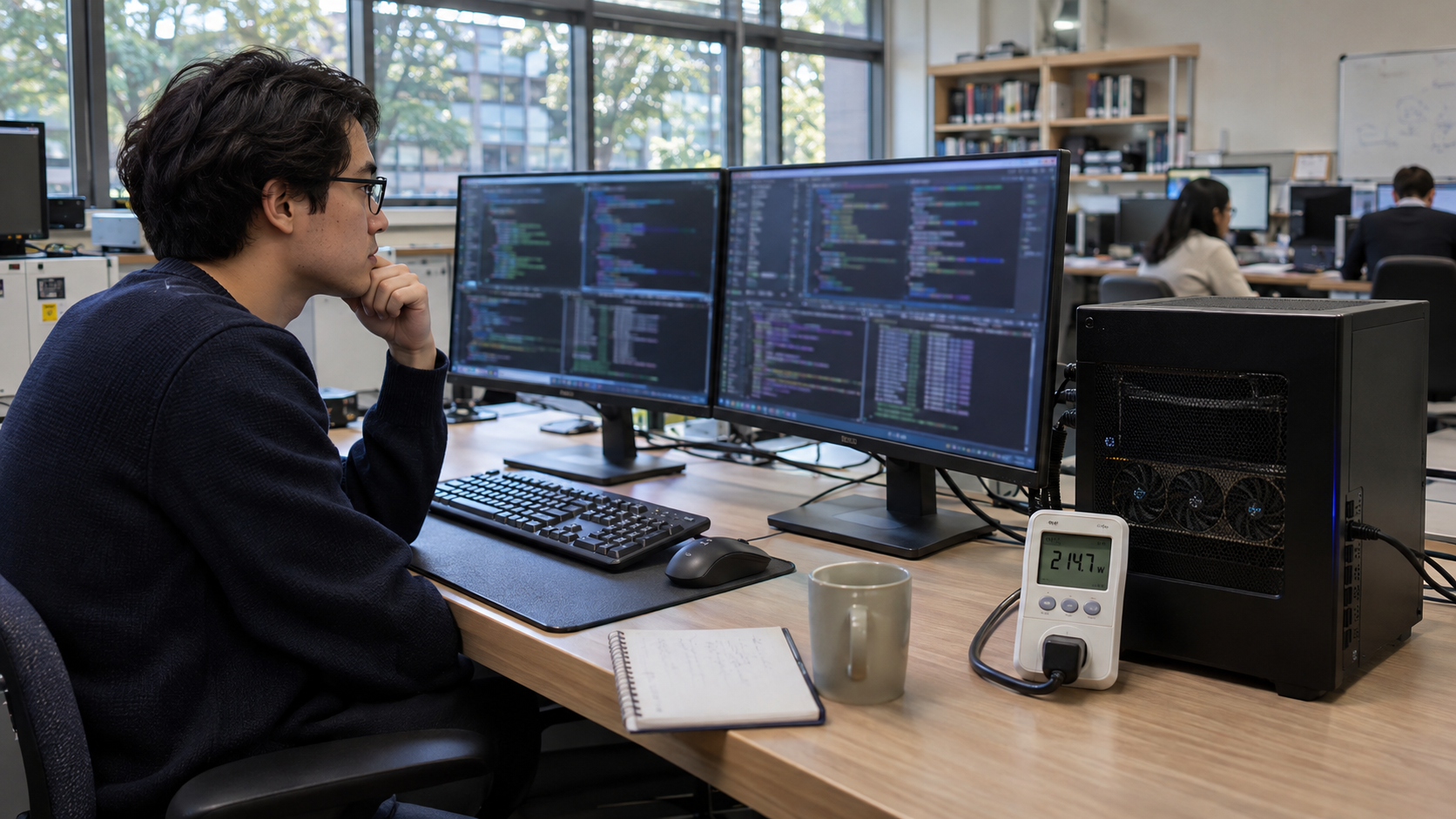
Response time measures how long a user waits. Energy measures the electricity consumed during the work.
A simple hypothetical example illustrates the distinction. A machine drawing a steady 200 watts for ten seconds consumes 2,000 joules. Two machines drawing 200 watts each for five seconds also consume 2,000 joules.
The second arrangement finishes sooner, but its energy consumption is identical under those assumptions. Actual computers have changing power demands, so a real comparison requires measurements throughout execution.
Parallel reasoning therefore needs at least two separate assessments: how quickly the system finishes and how much energy the complete process consumes.
That accounting must include the attempts that fail, the candidates that are discarded, and the process that checks the final answer. Measuring only the selected response would omit work performed to obtain it.
Smaller Models Offer Another Route
Parallel reasoning is also distinct from speculative decoding, although both involve concurrent computation.
In speculative decoding, a smaller model proposes tokens that a larger model checks. Google Research’s work on speculative cascades combines ideas from speculative decoding and model cascading, where tasks can be handled by models with different computational costs.
Google describes an important trade-off: accelerating generation can involve greater memory requirements and substantial continued work by the larger model. Speed improvements and computational savings consequently need separate evaluation.
For readers assessing an efficiency claim, the distinction matters. Multiple candidate solutions, concurrent subtasks, and parallel token verification are different mechanisms. A result for one does not establish the performance of the others.
The Answer Checker Is Part of the System
Generating a correct candidate is only part of solving a problem. The system must also recognize that candidate.
Microsoft’s investigation used a verifier with access to correct answers to explore how much improvement might be possible. That experimental arrangement helps identify potential, but a deployed system generally needs a checker that works without already knowing the answer. The researchers identified improved verification as an important development area.
Verification can be straightforward when an output has explicit conditions. A proposed schedule, for example, can be checked for overlapping appointments. An open-ended explanation presents a different problem: fluent wording alone cannot establish factual correctness.
What Would Demonstrate an Efficiency Gain?
A meaningful comparison would hold the workload and required answer quality consistent, then measure each complete method.
The report would specify the hardware, concurrent processes, total generated tokens, verification work, elapsed time, and measured energy. It would also explain whether unsuccessful attempts were included.
These measurements answer different questions. Shorter response time demonstrates a latency improvement. Higher accuracy at the same computational budget demonstrates a different gain. Lower measured energy at comparable quality supports an energy-efficiency claim.
Parallel reasoning has demonstrated benefits in particular experiments. Establishing its environmental value requires the additional step of measuring the electricity used to deliver reliable answers.
First-party sources
1. Learning Adaptive Parallel Reasoning with Language Models 2. Microsoft Research: Eureka Inference-Time Scaling Insights 3. Google Research: Speculative Cascades
Continue exploring: Visit Embedded Science for engineering and computing coverage.
Support independent technical reporting: Purchase an Embedded Science membership. Purchases do not automatically renew.