ADVERTISE WITH USReach Embedded Science readers →
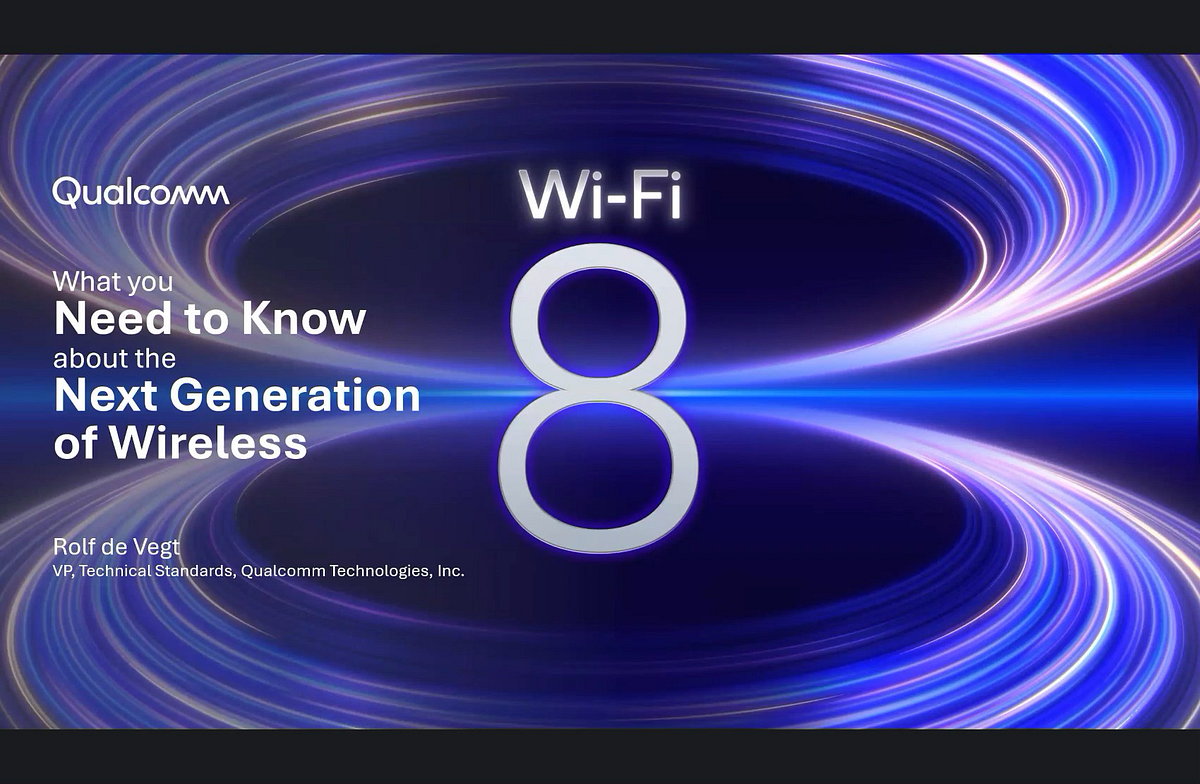
Wi-Fi 8: The Intelligent Foundation for the AI-Driven Era
Wi-Fi 8: The Intelligent Foundation for the AI-Driven Era
-
System-Level Integration: Moves beyond simple radio updates to co-optimize compute, RF front ends, and network intelligence.
-
Deterministic Reliability: Prioritizes predictable latency and stable connections over raw peak speeds to support real-time AI workloads.
-
Edge Intelligence: Features dedicated on-device AI acceleration to handle inference and network optimization without cloud dependency.
Describing the Shift to Wi-Fi 8
The transition to Wi-Fi 8 represents a fundamental pivot in how we conceive of wireless connectivity. While previous generations focused almost exclusively on increasing theoretical throughput, the “AI era” demands a different set of metrics. We are moving away from a “best-effort” model toward one defined by ultra-reliability and responsiveness. As AI applications move from bursty data patterns to continuous, upstream-heavy, and latency-sensitive workloads, the network can no longer be a “weak link.” Qualcomm’s Dragonwing Networking Portfolio addresses this by treating the network not just as a pipe, but as a foundational component of AI infrastructure that distributes intelligence across the edge-to-cloud continuum.
Outlining the Dragonwing Architecture
The architecture of this new generation is expressed through five distinct platforms, each built on a unified “silicon-to-cloud” stack. This ensures that whether a user is on a home mesh system or an enterprise access point, the underlying intelligence remains consistent.
-
Ethernet Platforms: The Dragonwing NPro A8 Elite serves premium tiers, while the Dragonwing N8 targets mainstream home routers.
-
Fiber Platforms: The FiberPro A8 Elite and F8 Platform integrate 10G fiber access with Wi-Fi 8 capabilities.
-
Fixed Wireless: The Dragonwing FWA Gen 5 Elite leverages the Qualcomm X85 Modem-RF System to combine 5G and Wi-Fi 8 for flexible broadband deployment.
These platforms are characterized by specialized engines: high-performance compute for services, dedicated packet processing for line-rate traffic, and network-centric intelligence for real-time Quality of Experience (QoE) optimization.
Explaining the Real-World Impact
The practical benefits of this system-level design are measured in reliability and scale. By utilizing higher-order 5×5 radio systems, these platforms increase spatial diversity, which translates to a 40% higher throughput at typical distances. In a domestic setting, this effectively extends high-speed coverage by an additional room. Furthermore, the inclusion of penta-band configurations allows the network to handle up to 1,500 simultaneous users, providing the headroom necessary for dense, device-rich environments.
Crucially, the “Developer-Ready” nature of the stack means these gateways are no longer static devices. Through containerized applications and native support for open-source middleware like Prpl and RDK, operators can deploy new AI services at the edge. This transforms the router into a programmable platform capable of evolving alongside the AI models it supports, ensuring that infrastructure remains a durable surface for innovation rather than a bottleneck.
The Qualcomm Dragonwing portfolio is categorized by its primary backhaul technology (Ethernet, Fiber, or 5G) and its performance tier. Below is a detailed breakdown of the five specific platforms that form the backbone of the Wi-Fi 8 ecosystem.
Qualcomm Dragonwing Platform Comparison
| Platform | Primary Connectivity | Target Market | Key Feature |
| Dragonwing NPro A8 Elite | Ethernet | Premium Enterprise & Home | Top-tier Wi-Fi 8 performance for high-density environments. |
| Dragonwing N8 | Ethernet | Mainstream Residential | Brings ultra-high reliability to standard home routers and mesh. |
| FiberPro A8 Elite | 10G Fiber | Premium Operator Gateways | Integrates 10G optical access with flagship Wi-Fi 8 intelligence. |
| Dragonwing F8 | 10G Fiber | Mainstream Operator Gateways | Cost-optimized fiber-to-Wi-Fi 8 transition for mass-market deployment. |
| Dragonwing FWA Gen 5 Elite | 5G (Snapdragon X85) | Fixed Wireless Access | Combines 5G mmWave/Sub-6 with Wi-Fi 8 for flexible broadband. |